What Should Private-Label Buyers Check Before Choosing a UVC LED Water Sterilizer Supplier?
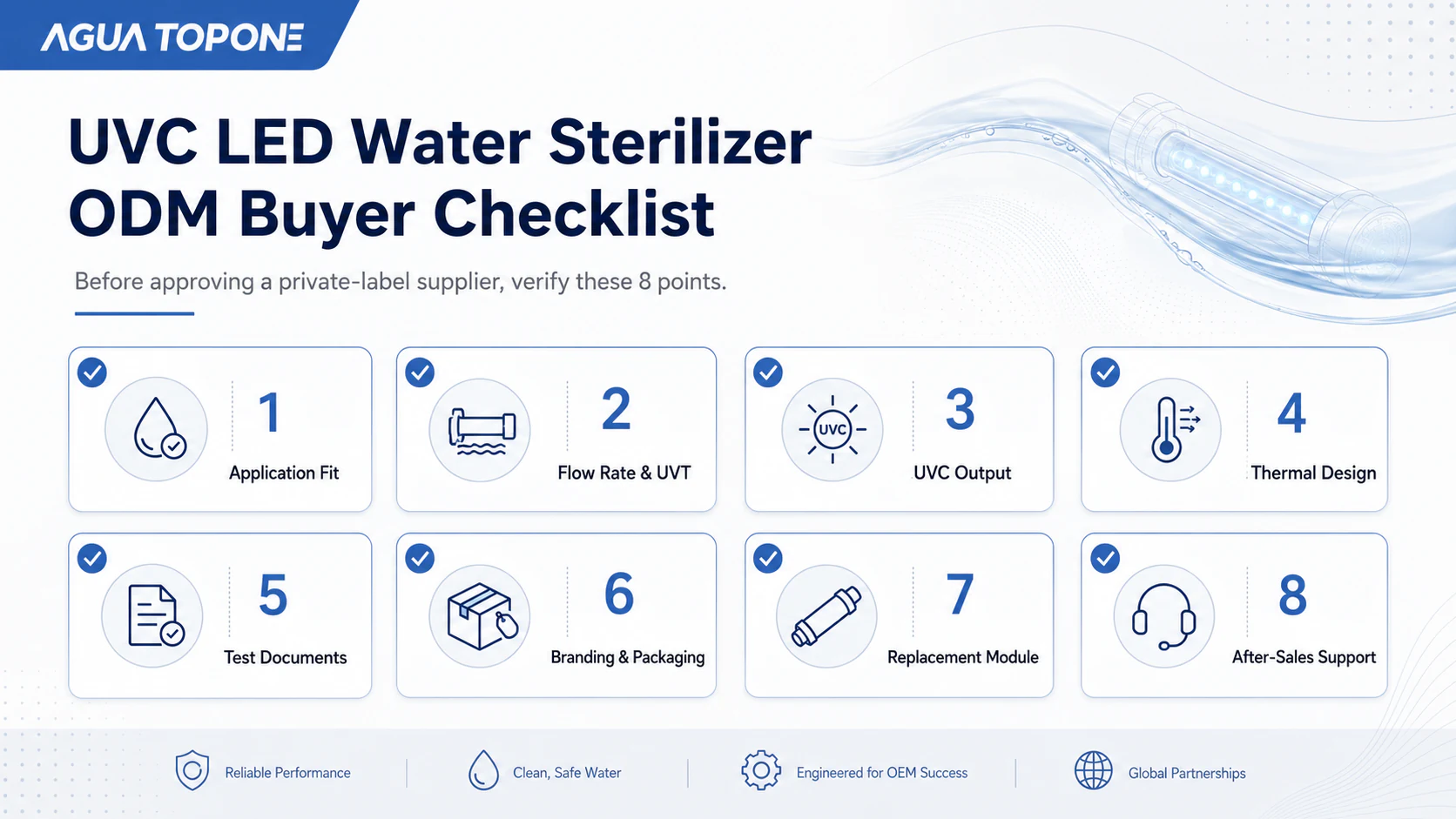
Private-label buyers should choose a UVC LED water sterilizer supplier only after they verify the supplier’s application fit, flow-and-UVT assumptions, UVC output basis, thermal and lifetime logic, testing documents, ODM execution process, and after-sales replacement support. This is a risk-management decision because field performance, warranty exposure, maintenance cost, and repeat-order consistency depend on real operating conditions and supplier discipline—not only on unit price.
Agua Topone’s current LED website is best positioned around ODM UVC LED water solutions and private-label support based on existing POU and POE UVC LED product platforms. That means the buyer should evaluate how well the supplier supports model selection, branding, packaging, documentation, replacement parts, and repeat-order consistency. Deeper OEM engineering can be discussed case by case, but this article focuses on the practical checks that private-label and ODM buyers should complete before approving a sample.
Why Supplier Choice Is a Risk-Management Decision, Not Only a Price Decision
A low quoted price can still create high commercial risk. The product may not match the buyer’s water quality, the flow claim may assume cleaner water than the real installation, the UVC output may drop under heat, or the supplier may fail to support documents, labels, spare parts, and repeat orders.
For private-label buyers, the product becomes part of their own brand. If the unit creates service problems in the field, the end user usually contacts the seller, installer, or brand owner first. Therefore, the buyer should compare suppliers by technical proof, documentation quality, and after-sales support—not only by ex-works price.
A practical supplier review should answer four questions:
- Does the selected model fit the real application?
- Can the supplier explain the water-quality and flow assumptions behind the recommendation?
- Can the supplier support the documents and customization needed for private-label sales?
- Can the supplier support replacement parts and repeat-order consistency after launch?
If these answers remain unclear, the buyer should delay sample approval.
1. Check the Real Application First
Do not approve a UVC LED water sterilizer sample before the supplier maps the model to a clear application. A faucet terminal, under-sink purifier, RO system, dispenser, RV line, whole-house POE system, and light commercial project do not share the same hydraulic behavior, installation space, service access, or user expectation.
Private-label buyers should provide the supplier with:
- target application,
- target flow rate,
- water source,
- UVT or basic water-quality information,
- installation position,
- inlet pressure if available,
- target market,
- voltage and plug requirement,
- branding and packaging requirement,
- and expected order plan.
These details help the supplier recommend a suitable platform instead of forcing one model into every project. Agua Topone’s POU and POE product structure can support this selection logic because compact point-of-use modules and whole-house point-of-entry systems solve different problems.
2. Check UVT and Flow-Rate Assumptions
UVT is not a small detail. It affects how much UVC light can pass through the water and reach microorganisms. Flow rate also matters because it affects exposure time inside the reactor.
If UVT drops, water absorbs more UVC before it reaches the target. If flow rises above the design range, water spends less time in the irradiated zone. As a result, two products with the same catalog flow can behave differently if the water quality, reactor design, and test assumptions are different.
Before choosing a supplier, ask:
| Question | Why it matters |
|---|---|
| What UVT value supports the model recommendation? | It shows whether the supplier understands real water conditions. |
| What peak flow rate should this model support? | It prevents selection based only on average flow. |
| Does the unit need pre-filtration? | Sediment, color, and turbidity can reduce UVC effectiveness. |
| Was the performance claim tied to a specific test condition? | It separates evidence from general marketing language. |
| Can the supplier review water data before confirming the model? | It reduces sizing and after-sales risk. |
For a deeper explanation, review Agua Topone’s guide to what UVT means in water treatment rather than repeat a full UVT lesson here.
3. Check UVC Output, Not Only Input Wattage
Many buyers compare UV products by wattage because wattage is easy to read. However, input wattage does not show how much useful UVC reaches the water.
A stronger comparison should include:
- UVC radiant output,
- wavelength range,
- optical design,
- reactor geometry,
- UVT and flow assumptions,
- stabilized operating condition,
- and test method.
For example, a whole-house POE model and a compact POU module may use very different power, optical output, flow, and control logic. Private-label buyers should therefore ask the supplier to explain how the selected model delivers the required performance under the buyer’s intended condition.
The safest rule is simple: do not buy by wattage alone. Ask for the output basis, the test condition, and the application range.
4. Check Thermal Design, Lifetime Logic, and Replacement Strategy
UVC LED systems need more than instant startup. They also need stable output and a clear service plan.
Heat can affect UVC LED output and accelerate output decline. In compact modules and sealed water-treatment products, thermal design affects long-term reliability. Therefore, private-label buyers should ask how the supplier manages heat, defines lifetime, and supports replacement.
Ask these questions before sample approval:
- How does the product move heat away from the UVC LED module?
- Does the supplier define service life with output-maintenance logic such as L70?
- Does the driver include a countdown or maintenance reminder?
- Is the UVC LED module replaceable?
- Can the supplier provide spare modules for after-sales support?
- Can installers or service teams replace parts without replacing the entire system?
This check matters because a unit can still power on while its UVC output has declined. A clear replacement path helps private-label buyers reduce service confusion, warranty disputes, and customer complaints.
5. Check Testing Evidence and Compliance Documents
A sample is not enough evidence. A responsible buyer should request documents before approving a private-label project.
Depending on the product, market, and application, the buyer may need:
| Document to request | What to check |
|---|---|
| Product datasheet | Model name, flow, input voltage, power, output, size, connection, and operating range |
| Test report summary | Model tested, test method, organism or method used, condition, result, and issuing party |
| Compliance declaration | Exact model scope, applicable market, issuing body, and validity |
| Material or water-contact document | Material scope and drinking-water-contact relevance where applicable |
| User manual draft | Installation rules, maintenance interval, warnings, and replacement instructions |
| Packaging specification | Carton artwork, labels, barcode, accessories list, and shipping marks |
| Spare-parts list | Replacement module, driver, sealing parts, lead time, and order rules |
| Warranty policy | Coverage, exclusions, evidence required, and failure-handling process |
| Sample approval form | Final model, logo files, voltage, plug, label text, carton approval, and revision control |
The key point is model-level clarity. If a supplier makes a performance or compliance claim, ask which model the document covers and which condition it supports. Do not assume one report covers every model, every market, or every flow rate.
6. Check ODM and Private-Label Execution Capability
Private-label buyers do not only buy a reactor. They buy launch execution.
A useful ODM/private-label supplier should help control:
- logo position,
- product label,
- model name,
- carton design,
- user manual,
- plug and voltage option,
- accessory list,
- packaging layout,
- barcode or carton marks,
- spare-parts package,
- and repeat-order revision control.
Before placing an order, ask:
- Which parts can carry our logo?
- Which label information is fixed and which can be edited?
- Can you provide artwork templates?
- Can you support manual and packaging customization?
- What is the MOQ for neutral sample, branded sample, and mass production?
- How do you control labeling and packaging consistency across repeat orders?
- Can you support a product-line plan across POU and POE models?
This is where Agua Topone’s current ODM/private-label positioning matters. The strongest public claim is not unlimited custom OEM engineering. The stronger and safer claim is that Agua Topone can support ODM/private-label projects around existing UVC LED water-disinfection platforms, with model selection, branding, documentation, packaging, and after-sales planning.
7. Check After-Sales, Spare Parts, and Replacement Support
After-sales support often decides whether a private-label UV product line grows or creates complaints.
Ask the supplier to confirm:
- replacement module availability,
- driver or control-box spare parts,
- sealing or accessory parts,
- troubleshooting guidance,
- installation support,
- warranty process,
- replacement lead time,
- batch traceability,
- and repeat-order consistency.
This step protects the buyer’s brand. A private-label buyer who ignores spare parts, replacement timing, and documentation may save cost at purchase but lose margin later through service claims and customer dissatisfaction.
Use This Supplier Checklist Before Approving a Sample
Before approving a UVC LED water sterilizer sample, score the supplier on the points below.
| Check item | What to verify | Why it matters |
|---|---|---|
| Application fit | POU, POE, RO, dispenser, RV, private water supply, or light commercial use | Prevents model mismatch |
| Operating envelope | Flow, UVT, water source, pressure, temperature, and installation condition | Defines the real use range |
| UVC performance basis | UVC output, wavelength, dose logic, and test condition | Avoids wattage-only comparison |
| Thermal design | Heat path, stabilized output, and operating environment | Supports output stability |
| Lifetime strategy | L70 logic, service interval, reminder driver, and replaceable module | Reduces after-sales risk |
| Test evidence | Model-specific test reports or test-method explanation | Supports performance claims |
| Compliance documents | Market-relevant declarations and material documents | Supports buyer due diligence |
| ODM execution | Logo, label, carton, manual, voltage, plug, MOQ, and artwork process | Supports private-label launch |
| Repeat-order control | BOM consistency, label revision control, carton consistency | Protects brand consistency |
| After-sales support | Spare parts, troubleshooting, warranty, and replacement lead time | Protects long-term service |
If several answers stay unclear at the sample stage, do not assume they will become clear after mass production starts.
Product Direction: POU and POE Options
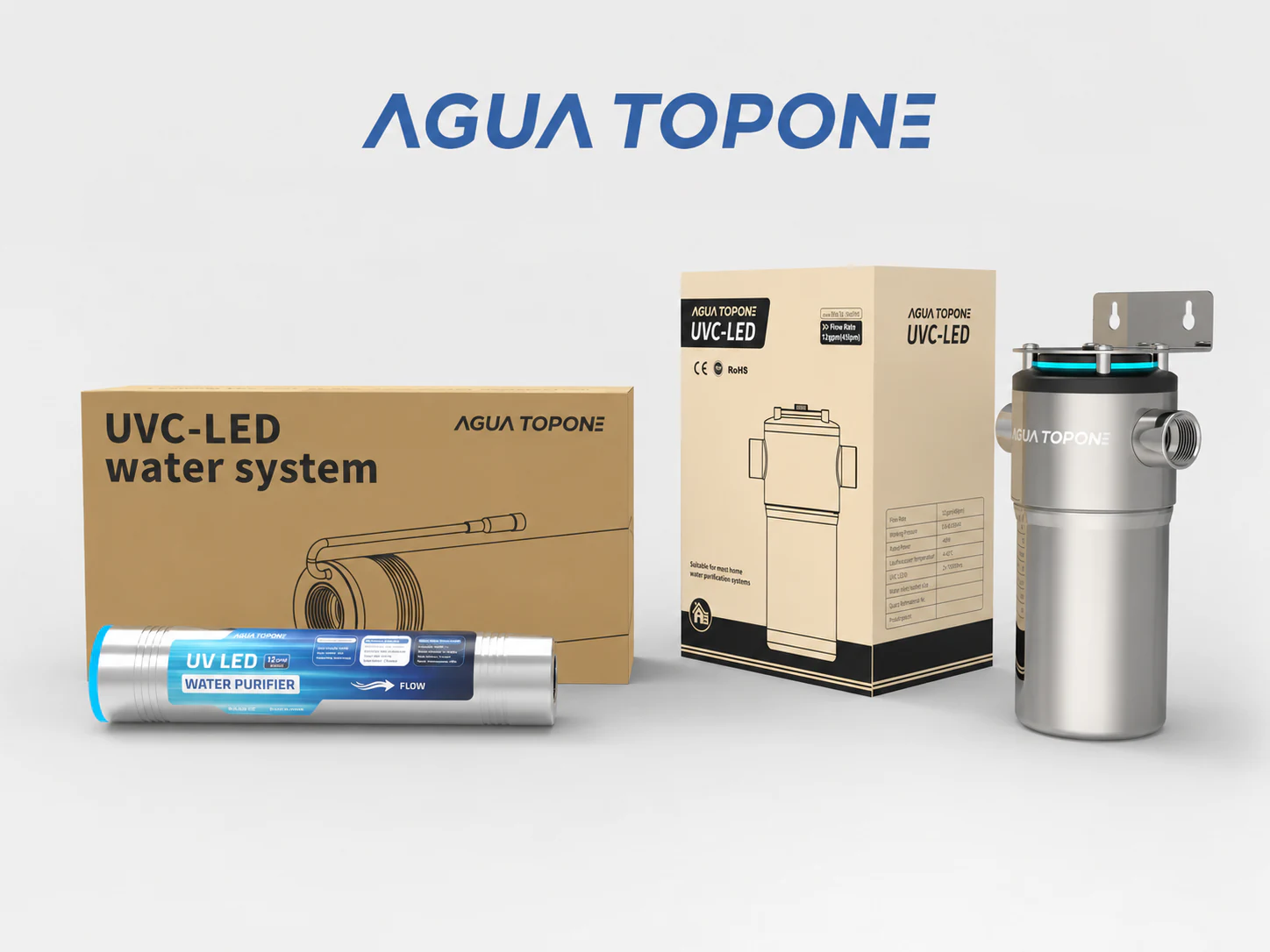
Agua Topone supports different private-label and ODM directions through POU and POE UVC LED water-disinfection platforms.
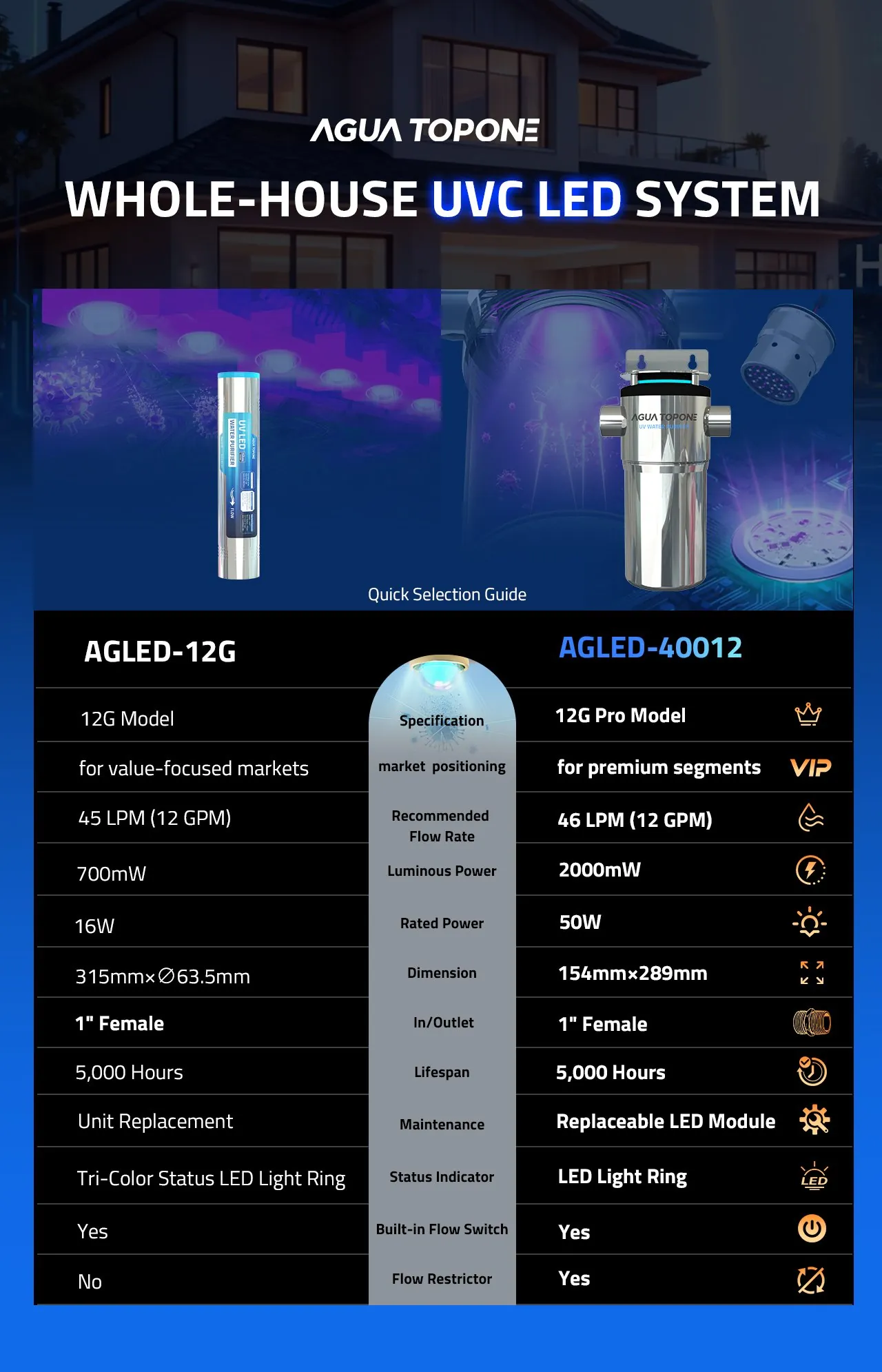
For compact applications, such as drinking terminals, under-sink systems, RO systems, dispensers, and appliance integration, buyers can review POU solutions such as AGLED-40002. These projects usually need compact size, stable control logic, documentation support, and clean integration.
For whole-house or private water supply applications, buyers can review POE systems such as AGLED-40012. These projects require closer review of flow rate, UVT, pre-filtration, pressure conditions, replacement module logic, and installation access.
This article does not replace model-specific sizing. Instead, it helps private-label buyers ask the right questions before they request a quotation, approve a sample, or launch a product under their own brand.
Final Takeaway
Private-label buyers should not choose a UVC LED water sterilizer supplier by price alone. They should check application fit, UVT, flow rate, UVC output, thermal design, lifetime strategy, testing documents, ODM execution, and after-sales support.
A strong supplier should make the project easier to launch and easier to support after shipment. A weak supplier may still deliver a low-cost sample, but it can create hidden risk through unclear performance assumptions, weak documentation, inconsistent packaging, and limited spare-parts support.
If you are building a private-label or ODM UVC LED water sterilizer product line, send Agua Topone your application, target flow rate, UVT or water-quality data, target market, voltage, branding, packaging, and documentation requirements. Our team can help review the model direction and recommend a suitable POU or POE UVC LED water-disinfection platform.