
Reverse osmosis
A final microbial-control stage for tanked or tankless RO systems after the required filtration stages.
POU UVC LED MODULE · 1 US GPM
Compact microbial control for RO systems and drinking-water appliances.
A stainless-steel, flow-triggered UVC LED module designed for the final treatment stage in point-of-use systems. Select it against real flow, water quality, pressure, voltage, fittings and target-market documents.
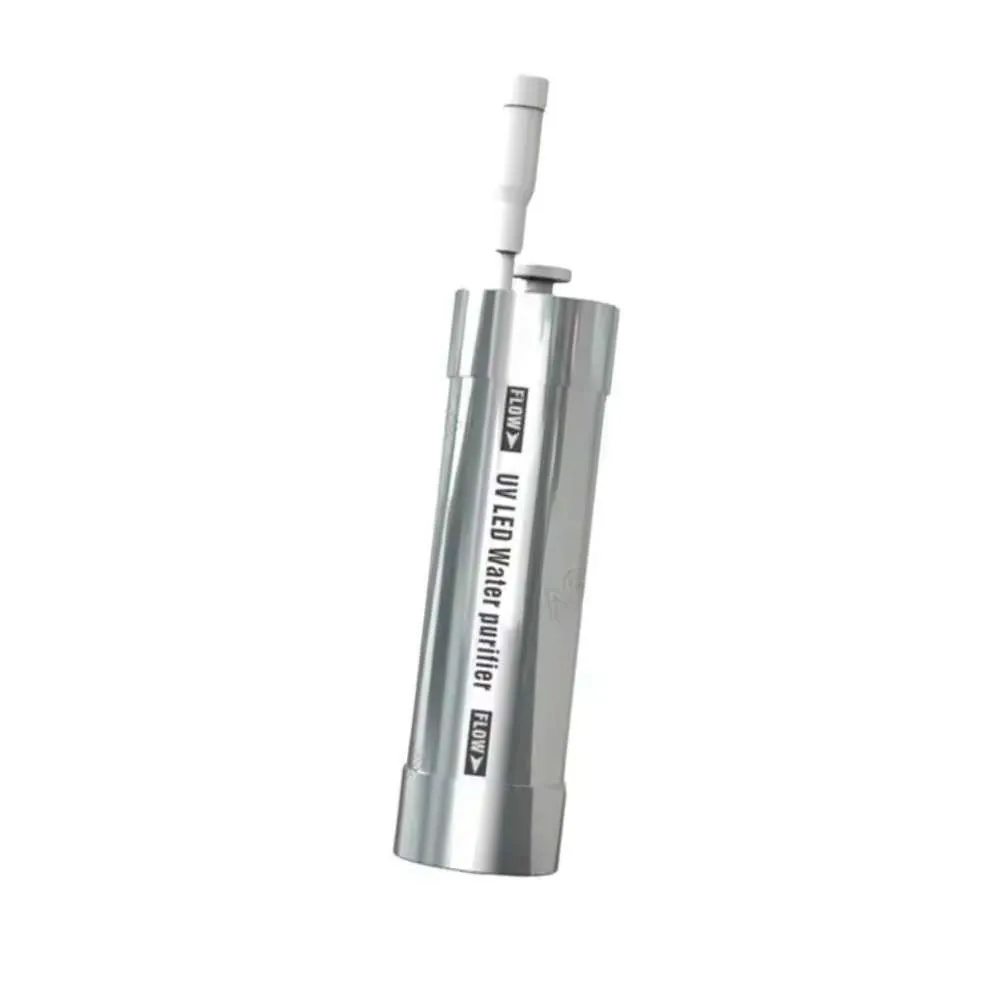
PRODUCT ROLE
AGLED-40002 uses UVC light alongside the sediment, carbon or membrane filtration selected for the complete drinking-water appliance.
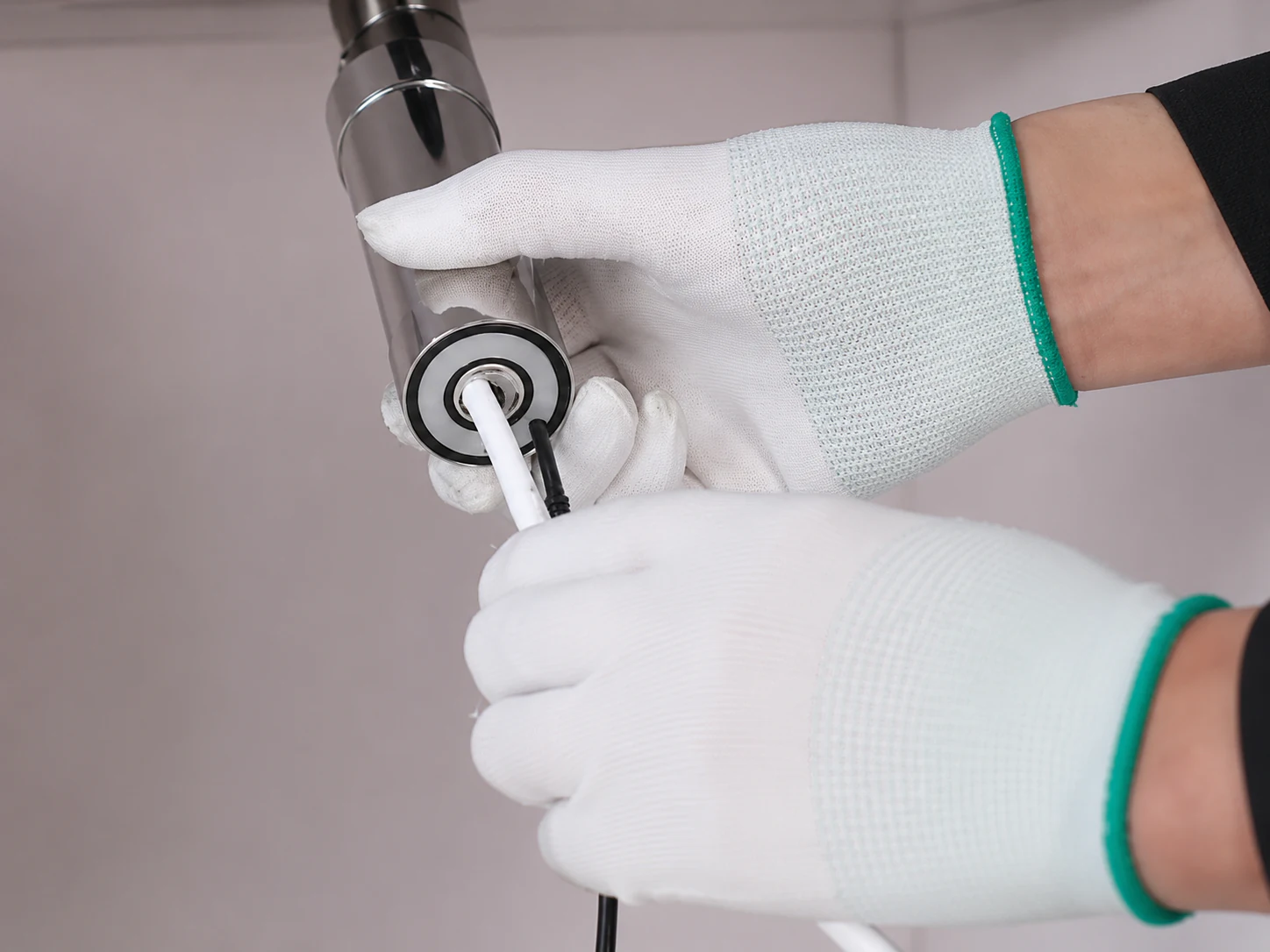
APPLICATION FIT
A final microbial-control stage for tanked or tankless RO systems after the required filtration stages.
Compact, on-demand treatment for drinking-water dispensers where peak flow and installation space fit the model.
Suitable for point-of-use terminals and faucet lines using a 1/4-inch quick-connect interface.
A stainless-steel module for appliance integration with a defined voltage version, flow logic and service plan.
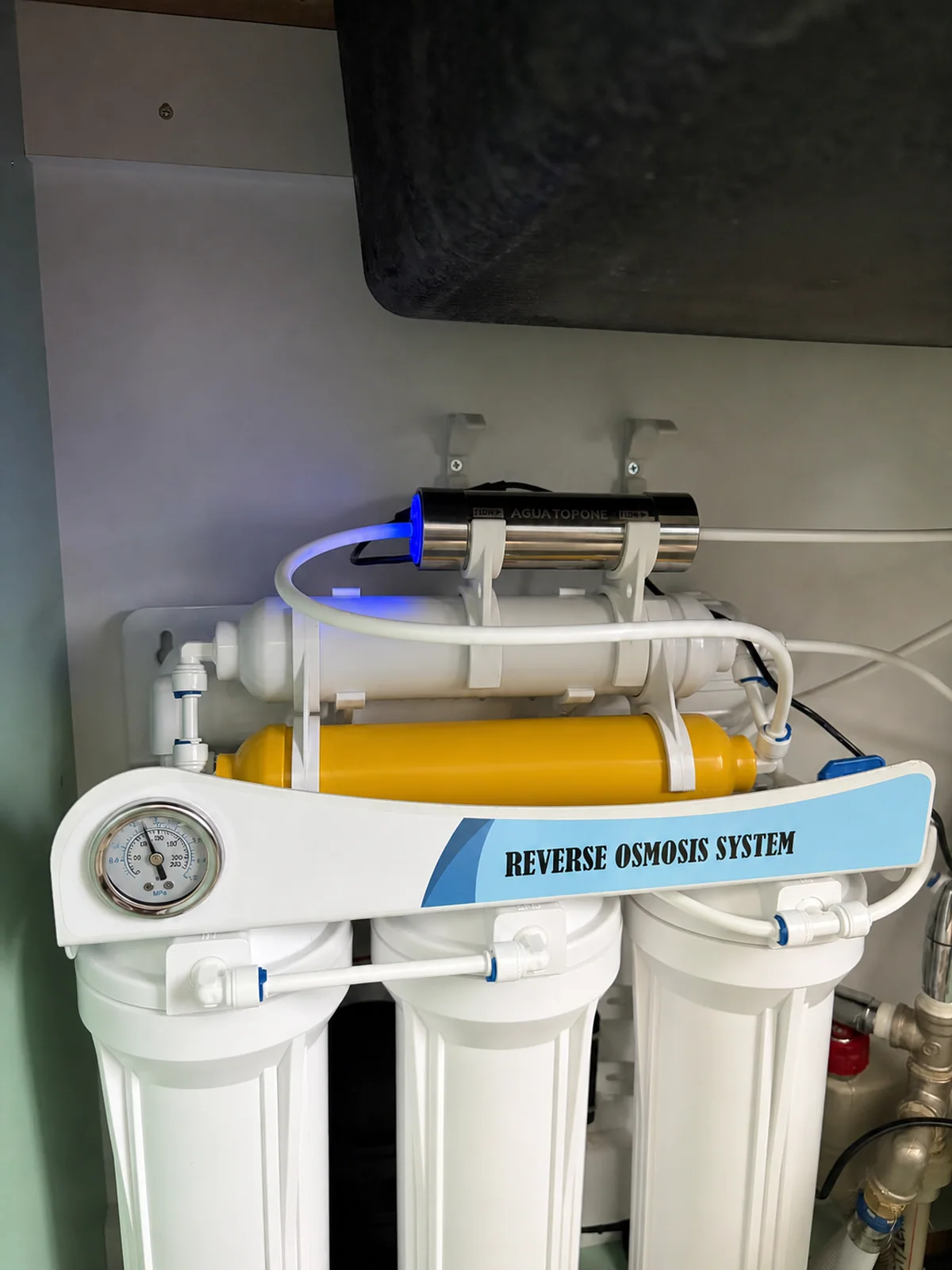
REAL INSTALLATION · BULGARIA
The installation report connects this product data to a real cabinet layout, including mounting position, service space, tubing, voltage and peak-flow checks.
ENGINEERING DATA
The current drawing, datasheet and manual are available for project review and quotation support.
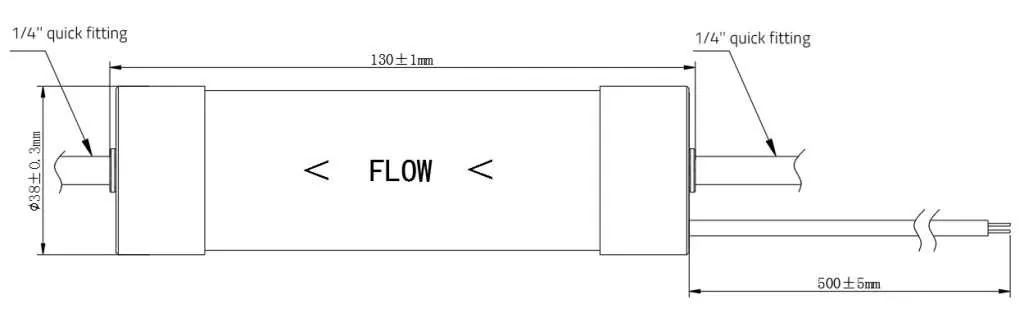
Hydraulic & mechanical
Electrical & optical
| No. | Parameter | Symbol | Value | Unit |
|---|---|---|---|---|
| 01 | Input voltage | VIN | 12 / 24 | V |
| 02 | Input power | W | ≤8 | W |
| 03 | UVC radiation power | Φe | 160 | mW |
| 04 | UVC peak wavelength | WLP | 270–280 | nm |
| 05 | Lifetime test | L70 | ≥5,000 | h |
Peak-wavelength and radiant-power measurement errors are ±3 nm and ±10%. The 12 V and 24 V entries refer to different model versions, not a wide-voltage design.
OEM INTEGRATION REVIEW
Our application team aligns the water path, flow direction, fittings, electrical control and model documents with the appliance design.
Peak flow, UVT, turbidity, temperature and upstream treatment.
Pressure, connection size, flow direction and service clearance.
12 V DC or 24 V DC, appliance logic and safe cable routing.
Match the exact model evidence to the project and target market.
MODEL-SPECIFIC EVIDENCE
The linked model report presents the organism, flow and water conditions behind this result; our team aligns them with the project duty.
Open SGS test reportThe report identifies the model, organism, flow and water conditions behind the performance result.
CE, ACS and NSF/ANSI/CAN 372 files are listed individually for review.
The table below lists pressure, sealing, environmental, vibration and packaging checks for this model.
These test conditions support technical review and product selection for the stated model.
Terminal-to-wire tensile force ≥30 N for 1 minute without loosening; welded wire-to-module tensile force ≥35 N without defects within 10 seconds.
1500 V / 50 Hz AC is applied between the live part and housing for 1 minute; the test sample remains undamaged.
Static pressure is held at 0.4 MPa for 5 minutes without air leakage.
Static water pressure is increased to 0.6 MPa within 5 minutes at a rate of ≤0.4 MPa/s and held for 15 minutes to check module water tightness.
Water pressure is raised to 0.8 MPa within 70 seconds, held for 5 seconds and released; appearance, mechanical and electrical performance remain normal.
10,000 repeated cycles at 0–0.45 MPa with a 2-second pressure rise are used to observe module water tightness.
The water-filled, blocked module is placed at −15°C for 48 hours and then thawed naturally; sealing performance remains normal.
The sample is stored at −15°C ±2°C for 72 hours and recovered at room temperature for at least 1 hour; appearance remains normal, and UVC intensity and module working current meet the drawing requirements.
The sample is stored at 50°C ±2°C for 72 hours and recovered at room temperature for at least 1 hour; appearance remains normal, and UVC intensity and module working current meet the drawing requirements.
The sample cycles 10 times between −15°C ±2°C and 85°C ±2°C with 30-minute holds and a 3-minute conversion time, then recovers at room temperature for at least 1 hour; appearance, UVC intensity and working current meet the drawing requirements.
The module is placed in a 40°C, 85% RH test chamber for 168 hours without damage, and all functions remain available.
The packaged product is tested at 4 Hz (240 CPM) for 60 minutes to ISTA-2001; packaging shows no obvious damage or deformation, the product surface and parts show no mechanical damage, and product function remains normal.
The inner and outer packaging boxes are each allowed to fall freely from 1 metre; packaging shows no obvious damage or deformation, internal fixtures show no obvious displacement, the product and parts show no mechanical damage, and electrical safety, performance and appearance meet the applicable requirements.
Module hazardous-substance content is checked against the limit requirements of the EU RoHS directive.
DOCUMENT CENTER
Drawings, performance reports, installation documents and market files are organized by purpose for easier project review.
APPLICATION REVIEW
Share your peak flow, water quality and integration requirements. Our application team will match the configuration and supporting documents.