
Source-water testing · Pretreatment · UV sizing
UV Light for Well Water: Treatment and System Selection Guide
UV can provide a final microbial-disinfection barrier for well water when the water is clear enough for UVC transmission and the reactor is sized for the real peak flow. It does not remove sediment, hardness, iron, manganese, chemicals or dissolved minerals.
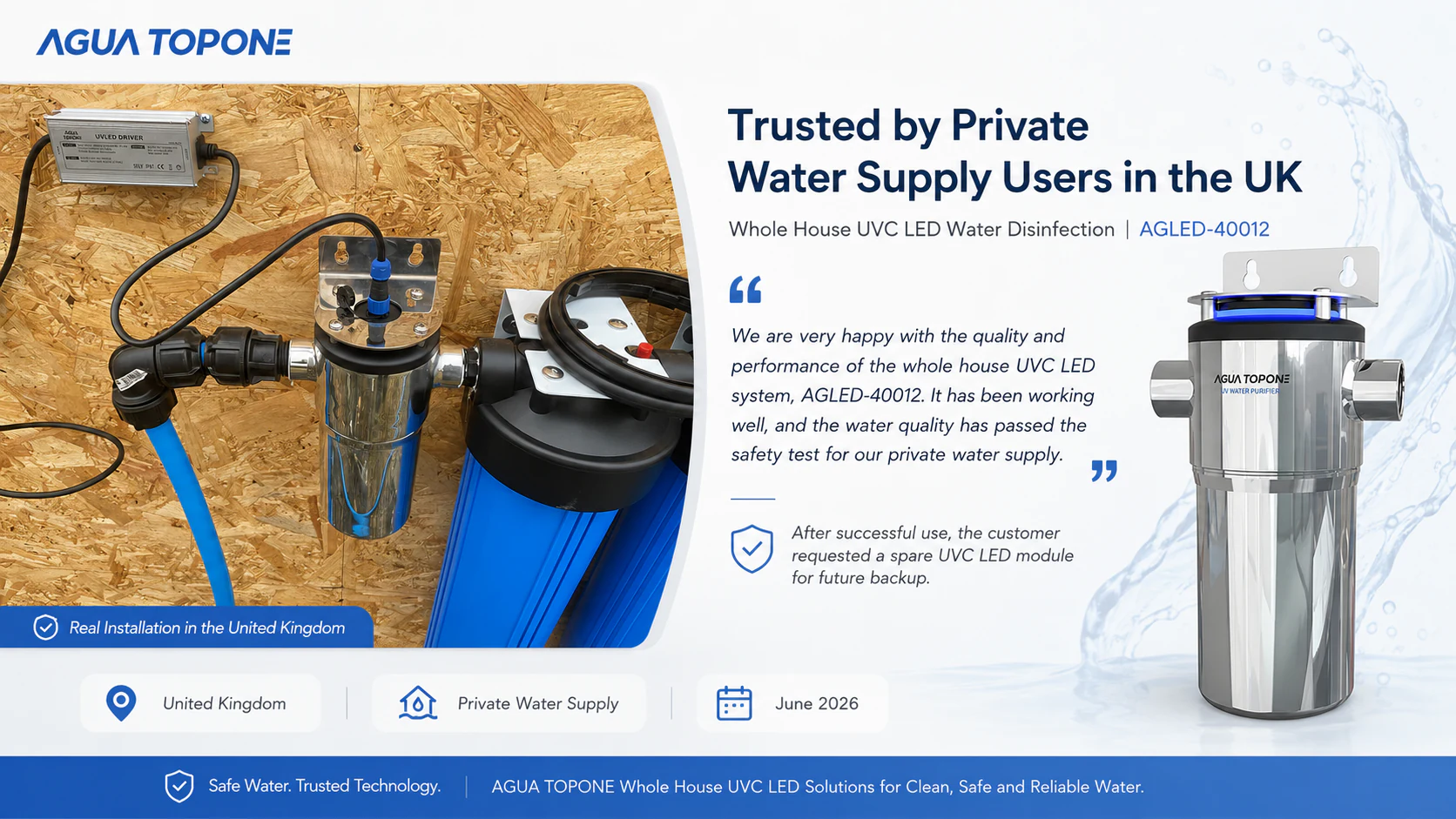
Private-water-supply installation reference using AGLED-40012. Final selection still depends on water analysis, peak flow and project conditions.
Does UV light work for well water?
Yes, UV light can be effective for microbial treatment of well water when the source water and equipment stay within the selected system's operating conditions. The key variables are the target organism, delivered UV dose, peak flow, UV transmittance (UVT), turbidity and fouling risk.
What UV does
UVC light treats microorganisms inside the reactor without adding a disinfectant chemical to the water stream. Model claims must remain tied to the tested organism, flow and water conditions.
What UV does not do
UV does not filter particles, soften water, remove iron or manganese, reduce TDS, or create a residual disinfectant in downstream plumbing. Those duties need separate treatment or maintenance controls.
If a well has an active contamination event, damaged casing, surface-water intrusion or unsafe chemical results, equipment selection should be coordinated with a qualified water-treatment professional and the applicable local authority.
Well-water tests to review before selecting a UV system
| Input | Why it matters | How to use it |
|---|---|---|
| Microbiological test | Identifies the current indicator-organism result and reason for treatment. | Use accredited local testing and follow retest guidance after installation or corrective work. |
| Peak flow | Delivered dose falls when flow exceeds the selected duty. | Measure simultaneous fixture demand; do not size only from average daily volume. |
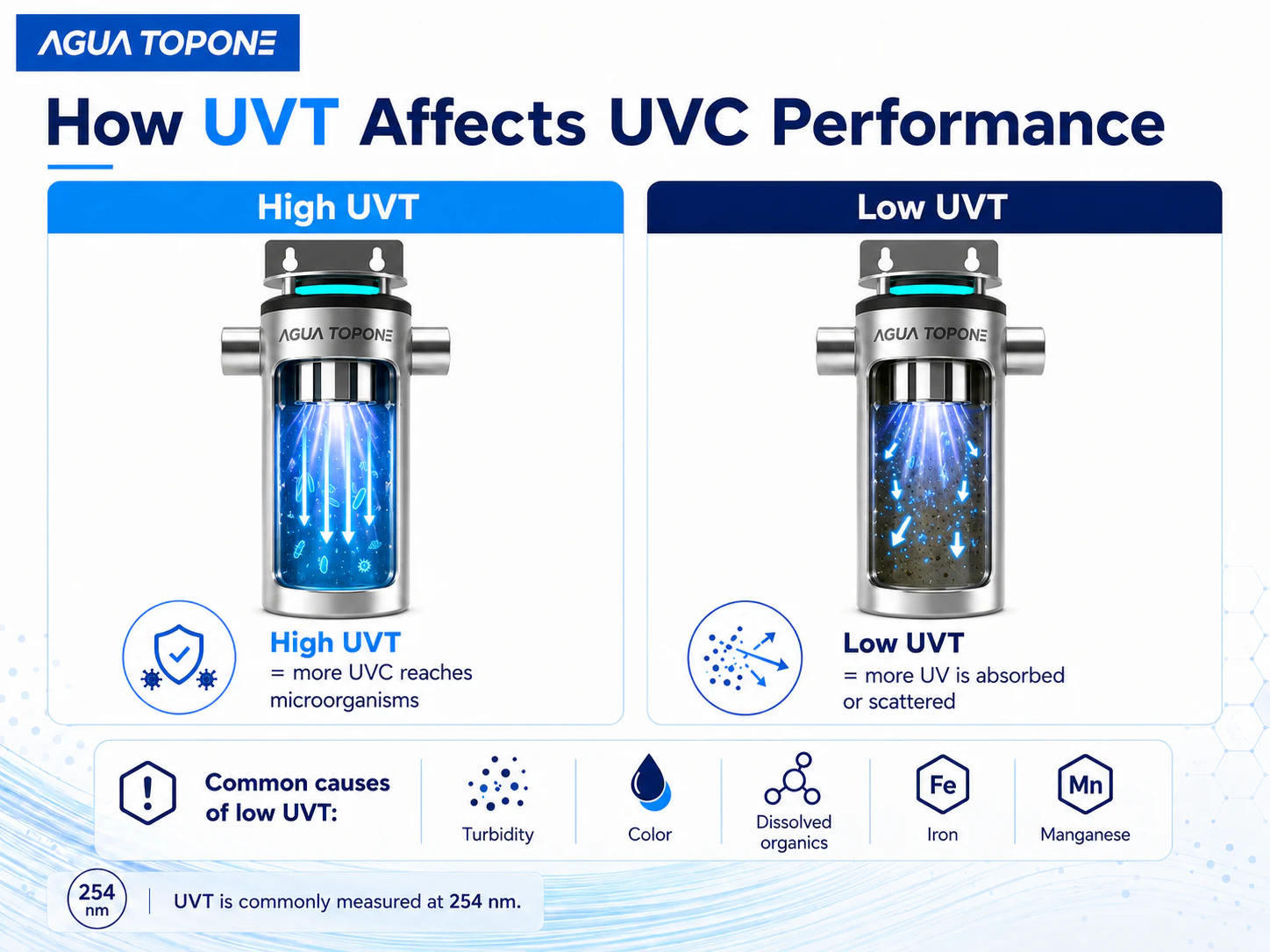
| UVT | Low UVT reduces how much UVC reaches microorganisms. | Use a measured value where possible and match it to the model's sizing basis. |
| Turbidity and suspended solids | Particles can absorb or scatter UVC and shield microorganisms. | Select sediment treatment according to the water analysis and system requirements. |
| Iron and manganese | Deposits can foul the optical surface and reduce transmission. | Use dedicated removal where results exceed the selected system's accepted inlet conditions. |
| Hardness | Scale can build on the optical surface and increase maintenance. | Assess softening or cleaning frequency from hardness, temperature and duty. |
| Pressure, temperature and connection | These determine mechanical fit and safe operation. | Match the complete installation to the selected model manual and local plumbing requirements. |
For initial VPS screening, the current owner manual lists turbidity below 1 NTU, total iron below 0.3 mg/L, hardness below 120 ppm, UVT above 90% and water temperature from 4–37°C. These are VPS model conditions, not universal limits for every UV system.
Water clarity changes UVC performance
UVT describes how much ultraviolet light passes through the water. Colour, dissolved organics, iron, manganese and turbidity can reduce transmission even when the water appears acceptable by eye.
Use a measured UVT value where possible. Pair it with the highest realistic simultaneous flow, then compare both inputs with the model's validated sizing basis.
Build the treatment train in the correct order
Collect microbiological and chemistry data and measure peak demand.
Inspect the cap, casing, drainage, storage and surface-water entry risks.
Address sediment, iron, manganese, hardness or other interference from the water report.
Protect UV transmission and follow the model's flow, orientation and service-access requirements.
Handle existing downstream contamination and verify the result using an appropriate sampling plan.
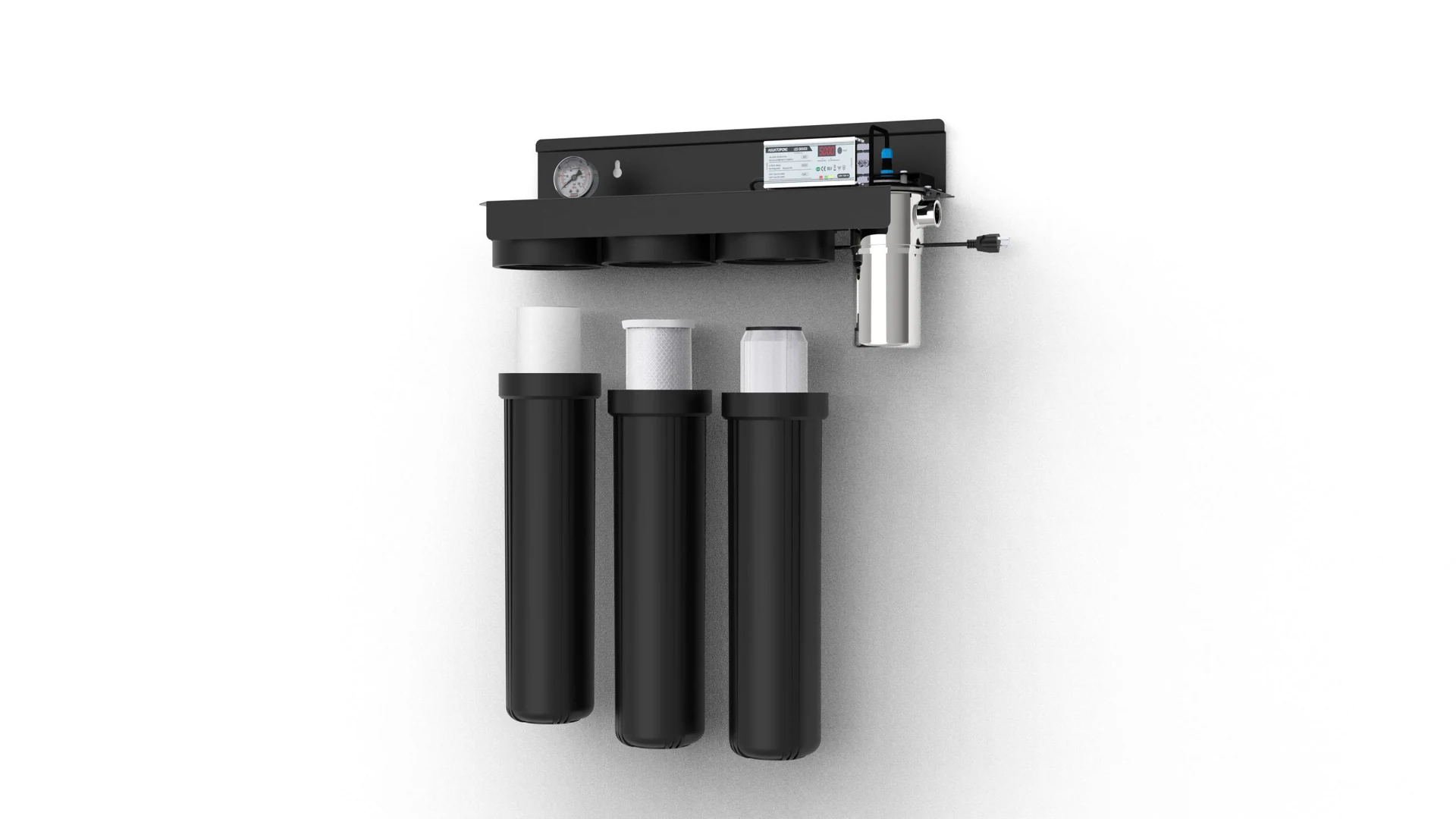
VPS-204 illustrates one integrated treatment train; the correct stages still depend on the source-water report.
Choose between POE, VPS and custom integration
Standalone POE UVC LED
Use the POE range when upstream treatment already prepares the water and the project needs a defined whole-house or light-commercial flow class.
VPS filtration + UVC
The VPS Series combines sediment/carbon stages with an AGLED-40012 UVC LED stage.
Conventional UV lamp systems
Lamp-based UV remains suitable for many established duties. Choose the platform from validated dose, flow, water quality, maintenance, approvals and economics.
OEM / ODM integration
Brands and system builders can use ODM support to review connections, voltage, controls, enclosure, documentation and validation.
If bacteria are still detected after UV installation
Do not assume the reactor alone is the cause. Work through the complete source, treatment, installation, plumbing and sampling chain.
Information to Include in a Well-Water Project Review
A useful project review connects source-water conditions, peak flow, treatment stages, commissioning and verification. Use the following information to assess system suitability and compare an installation with your own site conditions.
Related evidence and selection resources
Testing & Validation — review model-specific SGS reports and test conditions.
Certifications & Compliance — identify document types and model scope.
POE UVC LED solutions — compare whole-house flow classes.
VPS Series — review integrated filtration and UVC options.
Contact Agua Topone — submit the water report, peak flow and target market.
How to read microbiological evidence
Third-party testing supports a named sample under defined conditions. For example, SGS report NBF25-0021833-01 records greater than 99.999% total-coliform removal for AGLED-12G in a challenge test using E. coli ATCC 25922 at 50 L/min at the startup of operating life.
That result is evidence for the tested model and conditions; it is not a guarantee for every well, organism, flow or water quality. Review the complete SGS report library before citing a model result.
Send your well-water report and peak-flow requirement
We can separate pretreatment needs from UV disinfection, compare POE and VPS options, and identify which inputs still need confirmation before model selection.