AGLED-40002 Under-Sink RO Installation in Bulgaria
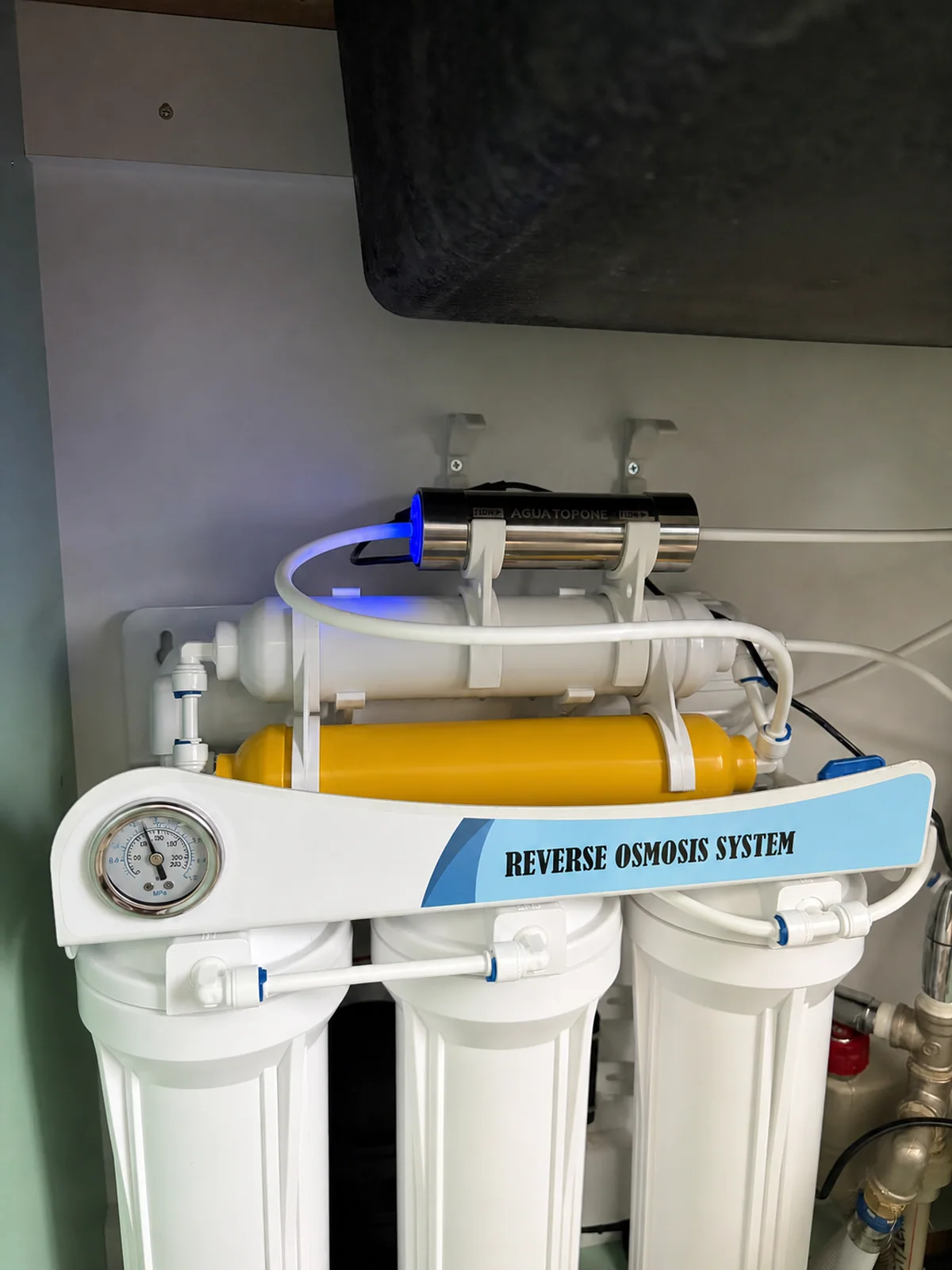
This Bulgaria installation gives RO system builders a practical answer to a common integration question: how can a compact UVC LED module fit into an existing under-sink cabinet without taking over the layout? The on-site photo shows the AGLED-40002 mounted above a multi-stage reverse osmosis assembly and connected to the cabinet's small-bore water line, with the blue status indicator visible in the photo. It is a useful physical-integration reference for OEMs, distributors and installers evaluating a similar point-of-use upgrade.
AGLED-40002 key product parameters
Published model data for preliminary RO-system selection. The 12 V and 24 V entries are separate model versions, not one wide-voltage input.
- Rated flow
- 4 L/min 1 US GPM
- Startup flow
- >500 mL/min Flow activation threshold
- Inlet / outlet
- 1/4 inch Standard quick-connect
- Maximum inlet pressure
- 8 bar 0.8 MPa
- Product dimensions
- Ø38 × 129 mm Allow extra service space
- Input voltage
- 12 V / 24 V DC Separate model versions
- Rated input power
- ≤8 W Published product data
- UVC output
- 160 mW 270–280 nm peak wavelength
What the on-site photo shows
 (opens in a new tab)
- Uses available upper space.The module sits above the RO assembly instead of occupying the service area around the vertical filter housings.
- Keeps key details visible.The blue status indicator and printed flow-direction marking are visible without removing the module.
- Shows a secured installation.Two mounting clips support the stainless-steel body, while the water line remains clear of the indicator.
- Documents a real POU context.The surrounding membrane housing, filter housings, pressure gauge and tubing show the module inside an installed RO cabinet rather than as an isolated product shot.
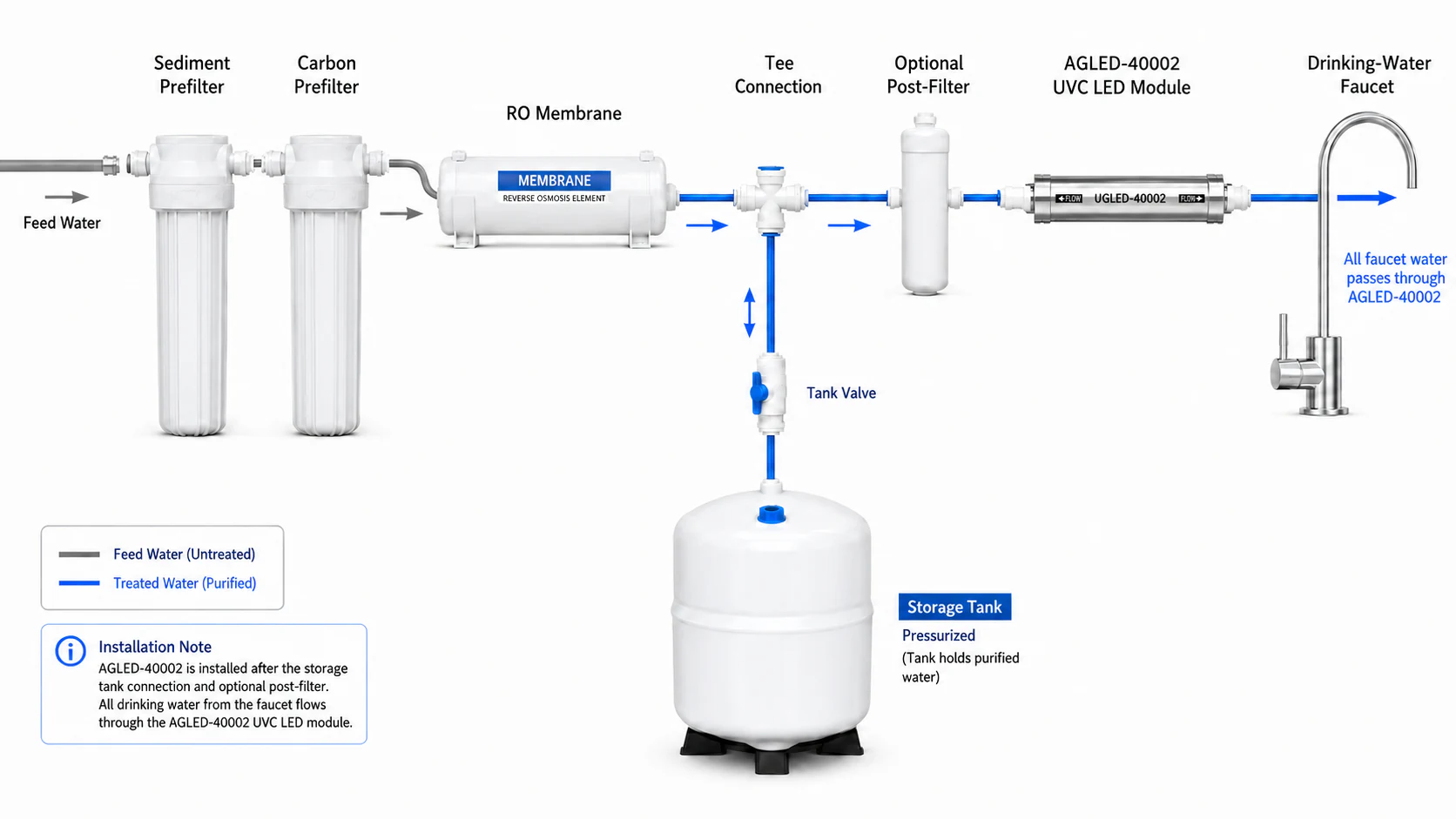
This real installation demonstrates a compact, service-friendly way to integrate AGLED-40002 into an under-sink RO cabinet: the module uses the available upper space, keeps the status indicator and flow marking visible, and leaves the filter-housing service area open. When adapting the layout, place the module in the final treated-water line and follow the marked flow direction in the system diagram.
Would AGLED-40002 fit your RO system?
The installation is most useful when it becomes a selection check, not just a gallery image. Compare the host appliance with these published AGLED-40002 requirements before using this layout as a reference.
Flow
Peak treated-water flow should remain within the published 4 L/min (about 1 US GPM) maximum.
Tubing
The module uses 1/4-inch standard quick-connect inlet and outlet connections.
Space
Allow for the Ø38 × 129 mm body plus the fittings, bend radius, cable routing and service access.
Power and control
Select the correct 12 V DC or 24 V DC model version. Flow activation starts above 500 mL/min.
Fast decision rule: if the treated-water flow, 1/4-inch interface, available envelope or DC supply does not match, the cabinet needs a different integration plan or model review before quotation. Water quality and pretreatment also remain part of the technical check because UVC performance depends on the actual water conditions.
Three UVC integration basics behind this layout
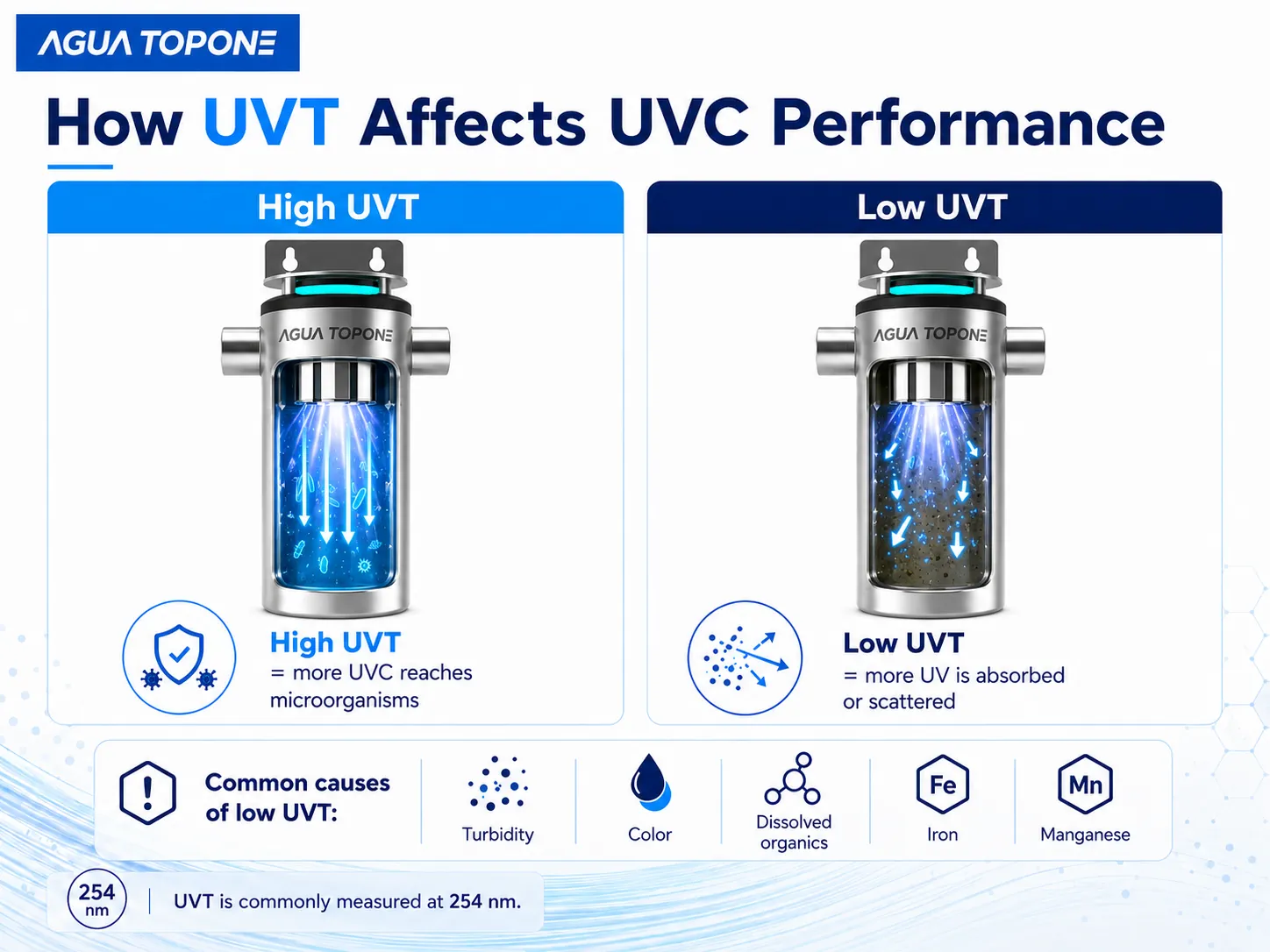
This installation is a useful physical reference, but a sound UVC integration still depends on three engineering checks. First, confirm that the module sits in the intended final treated-water path; the RO integration guide (opens in a new tab) explains how to review placement against the complete system diagram. Second, use peak—not average—flow when checking the model because exposure conditions change as water moves through the chamber; see the flow-rate guide (opens in a new tab). Third, review the actual treated-water optical conditions instead of assuming them from the appliance type alone; the UVT explainer (opens in a new tab) covers why ultraviolet transmittance matters.
These checks do not replace the product limits shown above. They connect the real installation photo to the wider design logic a system builder needs before selecting a model or finalizing the water path.
Model evidence available for technical review
The installation photo documents physical placement. The model documents answer the separate questions of tested performance, mechanical integration and target-market review.
Recorded for AGLED-40002 at 4 L/min under the conditions stated in SGS report NBF25-0016420-01.
Open SGS report ↗ (opens in a new tab)Review the installation sequence, flow direction, power connection, operating limits and service guidance before integrating the module.
Open installation guide ↗ (opens in a new tab)Open user manual ↗ (opens in a new tab)ACS and NSF/ANSI/CAN 372 low-lead files are available for project-specific review; applicability should be checked against the destination market and exact model scope.
Open ACS file ↗ (opens in a new tab)Open NSF 372 file ↗ (opens in a new tab)Evidence boundary: the SGS result is model-level laboratory evidence under the report conditions. It is not presented as a microbiological result measured at this Bulgarian installation.
Use this installation to brief your next project
For a useful model-fit response, send Agua Topone the same information an engineer would need to review the cabinet—not only a request for a price.
- A cabinet photo or drawingShow available mounting space, tubing routes and service access.
- Peak treated-water flowState the highest faucet or dispenser flow, not only the average.
- Available DC supplyConfirm whether the appliance provides 12 V DC or 24 V DC and how power is controlled.
- Tubing and water-path positionIdentify the connection size and the proposed position relative to the membrane, storage tank and faucet.
- Destination marketList the documents or approvals the project needs so the exact file scope can be checked.
With those five inputs, the discussion can move directly to model fit, installation constraints, document review and a quotation basis. See the complete AGLED-40002 engineering data (opens in a new tab), review the wider point-of-use application options (opens in a new tab), or browse more field references in Case Studies (opens in a new tab).