What Is UVT in Water Treatment, and Why Does It Matter for UVC LED Disinfection?
Direct Answer
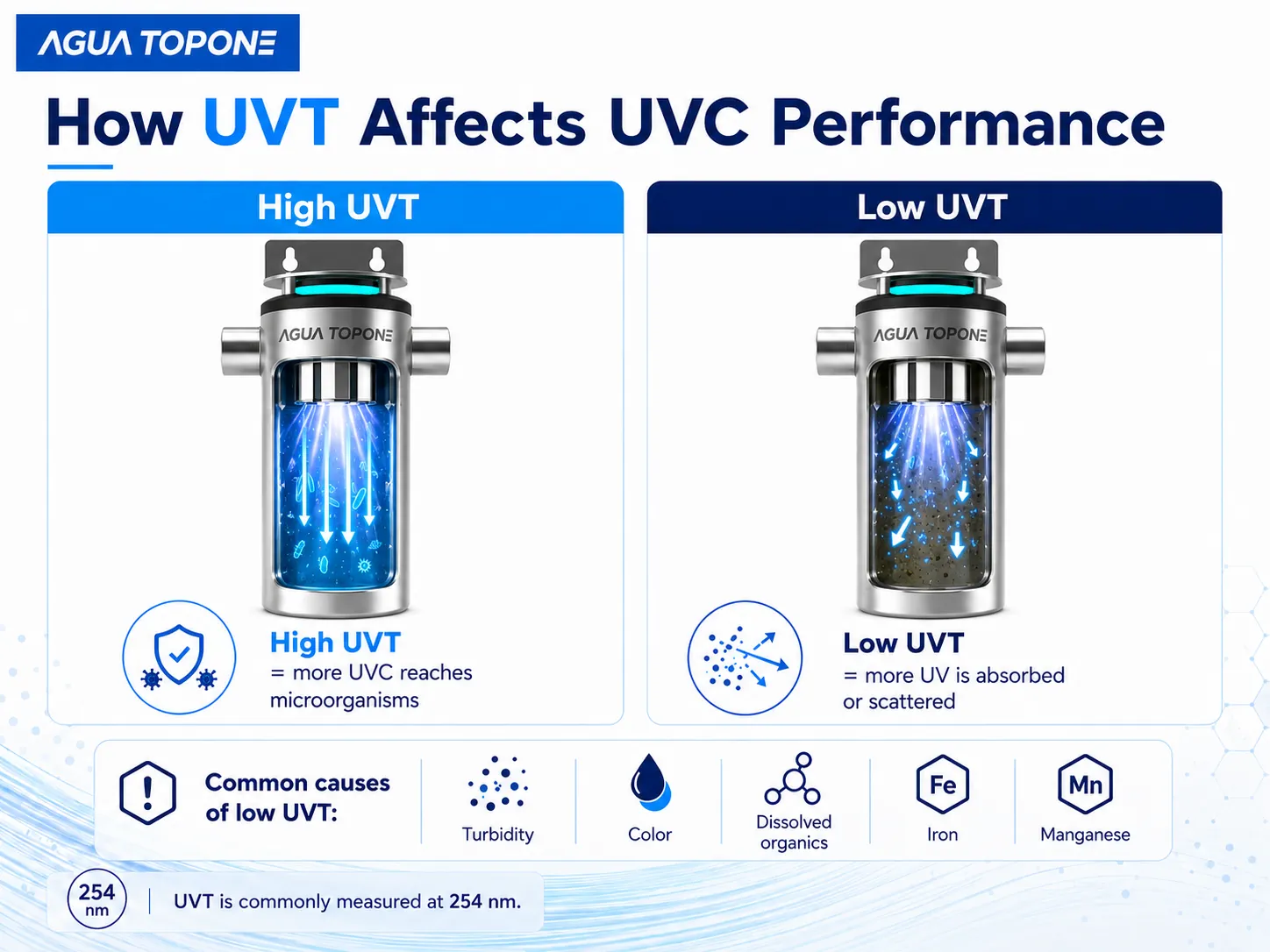
Executive summary: UVT, or ultraviolet transmittance, measures how much UVC light can pass through water at a specific wavelength, commonly 254 nm. Higher UVT allows more UVC energy to reach microorganisms, while lower UVT means more UV light is absorbed or scattered by turbidity, color, dissolved organics, iron, manganese, or other substances.
In water treatment, UVT matters because microbial inactivation depends on delivered dose, not installed LED power alone. When water absorbs or scatters UVC, microorganisms receive less fluence, and the system may need to compensate with lower flow, higher power, longer exposure, better pretreatment, or a combination of these factors. Our guide to UVC LED flow-rate validation (opens in a new tab) explains how hydraulic conditions interact with UVT and delivered dose. EPA guidance treats UVT as one of the most important water-quality characteristics affecting UV facility design because it directly influences UV dose delivery.
For AguaTopone’s audience, that point becomes even more important with LEDs. The water industry still reports UVT most often at 254 nm because legacy low-pressure mercury systems and A254 measurements set the baseline. However, UVC LEDs do not all emit at 254 nm. EPA guidance says that when the applied wavelength differs across the germicidal range, operators should also measure a UVT scan from 200–300 nm, because absorbance changes with wavelength. A full-scale 280 nm UV LED wastewater study confirmed that point: its reported UVT at 280 nm exceeded UVT at 254 nm for the same wastewater matrix.
In practice, high UVT gives a reactor design margin. Low UVT removes that margin first, then cuts allowable flow, and finally threatens validated performance. UK drinking-water guidance notes that UV equipment suppliers commonly specify minimum UVT values above 90–95% for drinking-water applications, while full-scale 280 nm UV LED wastewater disinfection has operated in much lower UVT bands, roughly 55–69%, but only with validated reactor performance and substantially higher operational demands.
So, what is UVT in water treatment, and why does it matter for UVC LED disinfection? UVT is the percentage of germicidal UV light that passes through water over a defined path length, and it matters because it directly controls how much UVC from the LED array reaches microorganisms. In other words, UVT decides achievable dose, validated flow rate, pretreatment needs, and real-world disinfection reliability.
What UVT Means in UVC LED Water Treatment
UVT is the fraction of incident UV light that passes through a sample over a specified distance. EPA expresses that relationship with Beer’s law as %UVT = 100 × I/I₀ and also as %UVT = 100 × 10^-A, where A is UV absorbance at the specified wavelength and path length. EPA also notes that the industry typically reports UVT at 254 nm and assumes a 1 cm path length unless stated otherwise.
That simple definition hides an important design truth: UVT does not tell you whether the water is microbiologically safe, and it does not equal turbidity. Instead, UVT tells you how optically permissive the water is to germicidal wavelengths. Standard Methods summary information lists interferences from colloidal particles, UV-absorbing organics, and several inorganics, especially ferrous iron, nitrate, nitrite, and bromide. EPA further explains that particles can scatter UV light in multiple directions and that conventional spectrophotometers may underestimate effective UVT because they miss some forward-scattered light.
For UVC LED systems, wavelength matters twice. First, NIST reports that above 240 nm many bacteria and viruses show peak relative UV sensitivity between 260 and 270 nm. Second, water absorbance usually decreases as wavelength increases across the germicidal band, which means the same water can look more transparent at 280 nm than at 254 nm. That tradeoff helps explain why LED designers choose wavelengths based on organism sensitivity, water UVT, LED output, cost, and lifetime rather than on a single “best” number.
That distinction matters on AguaTopone’s site because its public module data already points to LED-specific wavelengths and dose-oriented design. The AGLED-40002 (opens in a new tab) product page lists a peak wavelength of 270–280 nm, while AguaTopone’s POU solutions page (opens in a new tab) says typical design targets for common POU scenarios start at ≥30 mJ/cm² and states that effectiveness depends on delivered dose, water clarity, and flow. For LED water-treatment content, that means UVT254 should remain the industry reference, but UVT at the LED emission band should drive engineering decisions.
How to Measure UVT for UVC LED Systems
The baseline grab-sample method uses a UV-Vis spectrophotometer and a quartz cuvette. Standard Methods 5910B, as summarized by NEMI, measures UV absorption at 253.7 nm and normally filters the sample to control particle effects. EPA modifies that approach for UV disinfection work: it recommends measuring water without filtering or pH adjustment so the result reflects the water that the reactor will actually treat.
That baseline method remains useful, but LED systems often need one more step. EPA’s UVDGM and the newer EPA UV Toolkit both say that if the effective germicidal wavelengths extend beyond 254 nm, operators should consider a UVT scan from 200–300 nm. That recommendation appears in EPA’s guidance for polychromatic systems, but the logic also applies to LED reactors whenever wavelength-specific attenuation matters. If your reactor emits at 270–280 nm, one UVT254 number alone may not describe the optical reality inside the chamber.
A continuous UVT or UV254 analyzer adds operational value after commissioning. Hach states that continuous UV254 absorbance and UVT measurements support UV disinfection performance monitoring and offers path lengths from 1 mm to 50 mm, which is useful because weakly absorbing high-purity water and strongly absorbing wastewater require different optical path lengths. ABB’s UviTec analyzer similarly reports real-time UV254 or UVT for water and wastewater. DWI also recommends a continuous UV monitor and alarm or failsafe wherever practical.
EPA’s UV Toolkit adds a practical sampling rule that many OEM pages miss: if historical UVT data do not exist, EPA suggests weekly UVT measurement at first, and it recommends longer and denser data collection when the source shows seasonal changes, storm events, reservoir turnover, source blending, or upstream-treatment variability. That is exactly the right AEO answer for engineers asking when one spot measurement is enough: usually, it is not.
UVT measurement methods at a glance
The table below compares the three measurement approaches that matter most for UVC LED water systems. It reflects EPA guidance, Standard Methods summary data, and online analyzer manufacturer specifications.
| Measurement approach | Best use | Biggest advantage | Main limitation |
|---|---|---|---|
| Benchtop UV-Vis at 254 nm with quartz cuvette | Grab samples, commissioning, validation support | Gives the industry-standard UVT254/A254 baseline and supports direct Beer’s law conversion | Standard Methods traditionally filters the sample; for UV disinfection, EPA says do not filter or adjust pH, so lab protocol must match application |
| UVT scan across 200–300 nm | LED systems, wavelength-sensitive matrices, advanced design work | Captures wavelength dependence and shows whether UVT280 differs materially from UVT254 | Requires more interpretation and is often skipped in routine field work |
| Online UV254/UVT analyzer | Continuous control, alarms, seasonal trending, compliance support | Supplies real-time trend data for dose control and efficiency optimization | Needs calibration, cleaning, and path-length selection that matches the matrix |
Practical recommendation for AguaTopone-oriented content: publish both UVT254 and wavelength-relevant UVT whenever the module emits away from 254 nm, especially for 270–280 nm LED products. That recommendation follows EPA’s scan guidance and fits AguaTopone’s own 270–280 nm product data.
What UVT Ranges Mean in Practice
No single UVT threshold works for every application, because reactor geometry, wavelength, path length, hydraulics, fouling, and the validated operating envelope all matter. Still, reported values from guidance documents and peer-reviewed studies give useful engineering context. DWI says drinking-water UV suppliers commonly specify minimum UVT values above 90–95% for private-water UV systems. Jarvis and co-authors reported 90–97% UVT at 275 nm for post-filtration drinking water in a full-scale LED validation study. By contrast, a full-scale 280 nm wastewater UV LED reactor operated at average UVT254 of 54.6–66.2% and UVT280 of 59.9–68.7%. A 2024 Water Research study also tested 280 nm UVC LED disinfection on filtered water at UVT280 90.2% and on severe WHO challenge water at UVT 15.7%.
Representative UVT ranges for water matrices relevant to UVC LED design
These values are representative reported or specified values, not universal design limits. Use them to frame audience expectations, not to replace reactor validation.
| Water type or matrix | Representative UVT | Wavelength basis | What it usually means |
|---|---|---|---|
| Filtered municipal drinking water in a full-scale LED study | 90–97% | UVT275 | Very clear finished water suitable for validated drinking-water UV operation |
| Drinking-water supplier minimums often cited for private-supply UV | >90–95% | Typical supplier specification basis | Clear-water expectation for household and whole-house UV treatment |
| Filtered water in a 280 nm UVC LED bench study | 90.2% | UVT280 | Clear-water condition for strong POU-style LED performance |
| Full-scale municipal wastewater in a 280 nm LED reactor | 54.6–66.2% UVT254; 59.9–68.7% UVT280 | UVT254 and UVT280 | Challenging but still treatable with validated wastewater design |
| WHO challenge water used in 280 nm UVC LED testing | 15.7% | UVT280 | Severe low-UVT stress water, useful for robustness testing rather than normal design targets |
| RO permeate in a reported advanced-reuse RO operation | about 100% | UVT for UV/AOP context | Extremely UV-permissive water in a reported reuse case |
Two patterns matter most. First, finished drinking water and polished reuse water often sit in the high-UVT zone, where compact UVC LED reactors gain the most design freedom. Second, wastewater and colored, iron-bearing, or high-organic waters can still be treatable, but only if the reactor, controls, and pretreatment are designed for that matrix from the beginning.
How UVT Changes Delivered Dose and What to Do When It Drops
Beer’s law makes the UVT problem visible immediately. If your 1 cm UVT falls from 95% to 70%, the relative transmitted UVC through a 2 cm optical path drops from about 90% to 49%. If it falls to 50%, only about 25% of the incident UVC remains after 2 cm. EPA therefore treats UVT as a primary design and operational variable. The table below uses EPA’s equations to show the magnitude of that effect; the percentages are illustrative optical calculations, not complete reactor-dose predictions, because real reactors also depend on chamber geometry, hydraulics, wavelength, and fouling.
Illustrative impact of UVT on transmitted UVC
| UVT at 1 cm | Equivalent absorbance A | Relative UVC transmitted through 1 cm | Relative UVC transmitted through 2 cm | Design implication |
|---|---|---|---|---|
| 95% | 0.022 | 95% | 90.2% | Comfortable margin for clear drinking water |
| 90% | 0.046 | 90% | 81.0% | Still strong, but less headroom |
| 80% | 0.097 | 80% | 64.0% | Tightens flow and power margins |
| 70% | 0.155 | 70% | 49.0% | Often outside the intended zone for clear-water household UV |
| 60% | 0.222 | 60% | 36.0% | Demands validated wastewater or specialty design |
| 50% | 0.301 | 50% | 25.0% | Usually calls for lower flow and stronger pretreatment |
| 15.7% | 0.804 | 15.7% | 2.5% | Severe stress case, not routine feed water |
When UVT drops, smart operators do not start with the LEDs. They start with the water. DWI advises prefiltration to control turbidity and particle shielding, activated carbon or membranes to reduce color, and oxidation plus filtration to control iron and manganese. EPA’s UV Toolkit adds calcium, alkalinity, hardness, iron, manganese, pH, and ORP to the fouling discussion because sleeve and sensor-window fouling reduce delivered dose even when the source UVT stays constant.
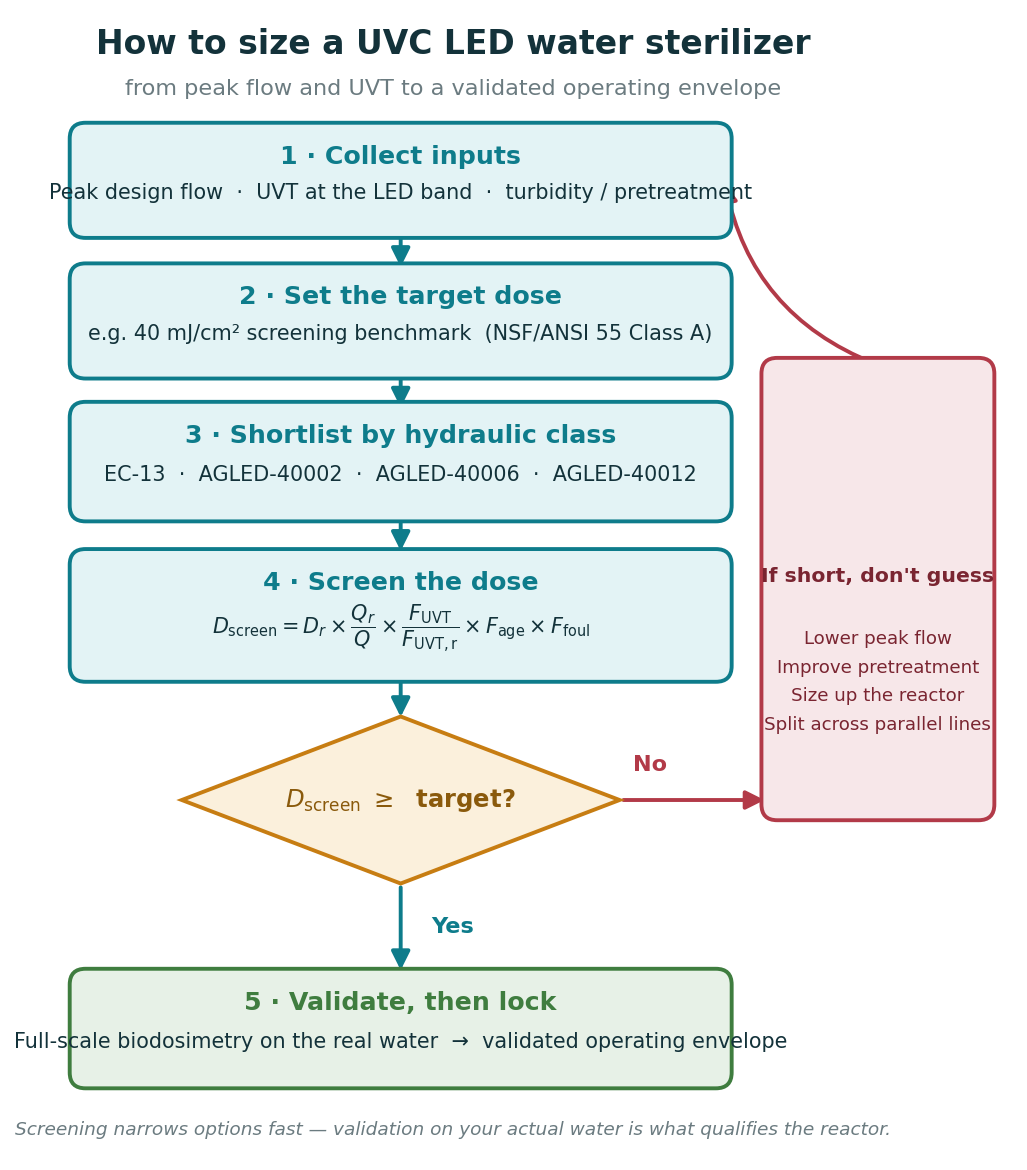
That leads to a clean decision rule for OEMs and system integrators: treat low UVT as a pretreatment and validation problem before you treat it as a power problem. If UVT falls below the validated envelope, reduce flow, increase exposure only within validated limits, inspect pretreatment, clean optics and sensors, and remeasure at the UV installation point. EPA explicitly ties off-spec operation to validated conditions, and DWI emphasizes that flow rate, water quality, and maintenance all control actual disinfection. For a practical selection workflow, see how to size a UVC LED water sterilizer by flow rate and UVT (opens in a new tab).
Planning a whole-house or equipment-integration project? Review our POE UVC LED solutions (opens in a new tab) and the AGLED-40012 whole-house system (opens in a new tab). For model selection, contact Agua Topone (opens in a new tab) with your water source, UVT value, target flow rate, installation type, connection size, and available voltage.
FAQ
What is UVT in water treatment?
UVT, or ultraviolet transmittance, is the percentage of germicidal UV light that passes through water over a defined path length, usually 1 cm. Higher UVT means more UVC reaches microorganisms, which helps the reactor deliver the intended dose.
What UVT is considered good for UVC LED water treatment?
For clear drinking-water applications, suppliers commonly specify UVT above 90% to 95%. Wastewater systems can operate at much lower UVT, but they need validated reactor design, tighter controls, and stronger pretreatment.
Should a UVC LED system use UVT254 or UVT280?
UVT254 remains the industry reference, but a UVC LED system should also consider UVT at the LED emission wavelength when the reactor emits away from 254 nm. For 270–280 nm LEDs, a UVT scan from 200 to 300 nm gives a more accurate picture of real attenuation.