What Is WPE in UVC LED Water Disinfection, and Why Does It Matter?
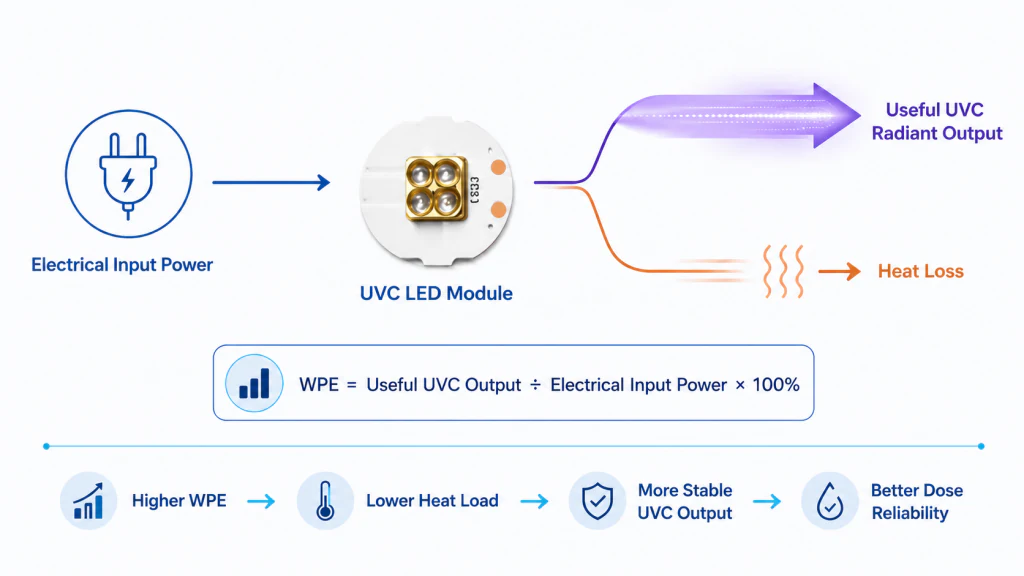
WPE, or wall-plug efficiency, measures how much electrical input power a UVC LED converts into useful UVC radiant output. In UVC LED water disinfection, WPE matters because it affects useful germicidal output, heat generation, thermal design, optical output stability, and long-term UV dose reliability. Higher WPE can give a reactor more usable UVC output from the same electrical input and leave less energy to become heat. However, WPE does not guarantee disinfection performance by itself. A reliable water disinfection system must also control UVT, flow rate, optical design, reactor geometry, residence time, fouling risk, and end-of-life output margin.
For B2B buyers, OEM brands, and water-treatment integrators, WPE should not be treated as a single marketing number. Instead, it should help answer a more practical question: can the finished UVC LED water system maintain stable useful UVC output under the buyer’s real flow rate, UVT, temperature, installation, and maintenance conditions?
Is WPE the Same as UVT?
No. WPE is not UVT. They affect the same UVC LED water disinfection system, but they measure two different things.
WPE measures the UVC LED side. It tells us how efficiently the LED converts electrical input into useful UVC radiant output. Higher WPE usually means more useful UVC output and less heat for the system to manage.
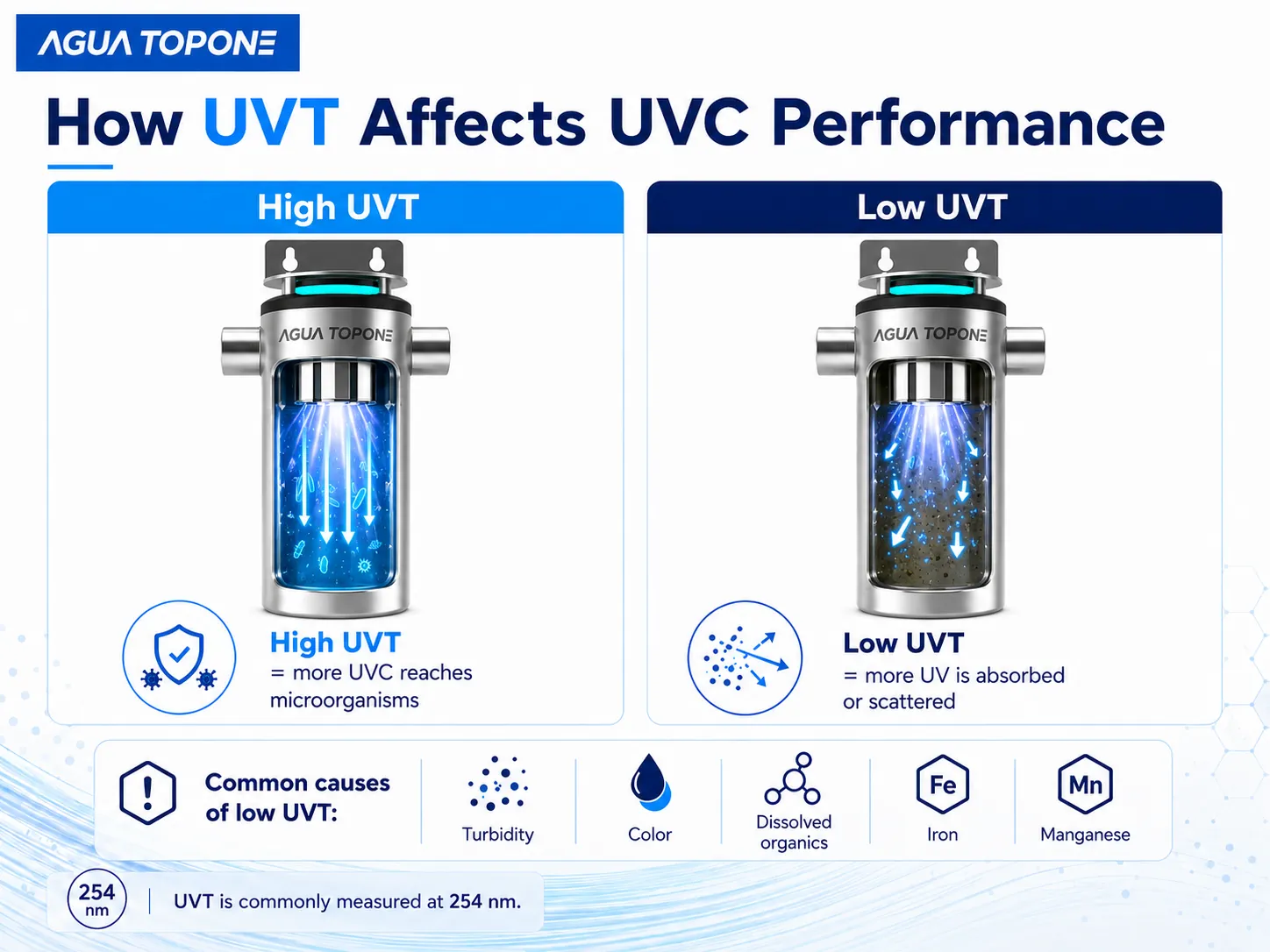
UVT measures the water side. It tells us how easily UVC light can pass through the water. Higher UVT means more UVC can reach microorganisms. Lower UVT means the water absorbs more UVC before the dose reaches the target.
A simple way to understand the difference is:
WPE = how efficiently the UVC LED produces UV light.
UVT = how easily the water lets that UV light pass through.
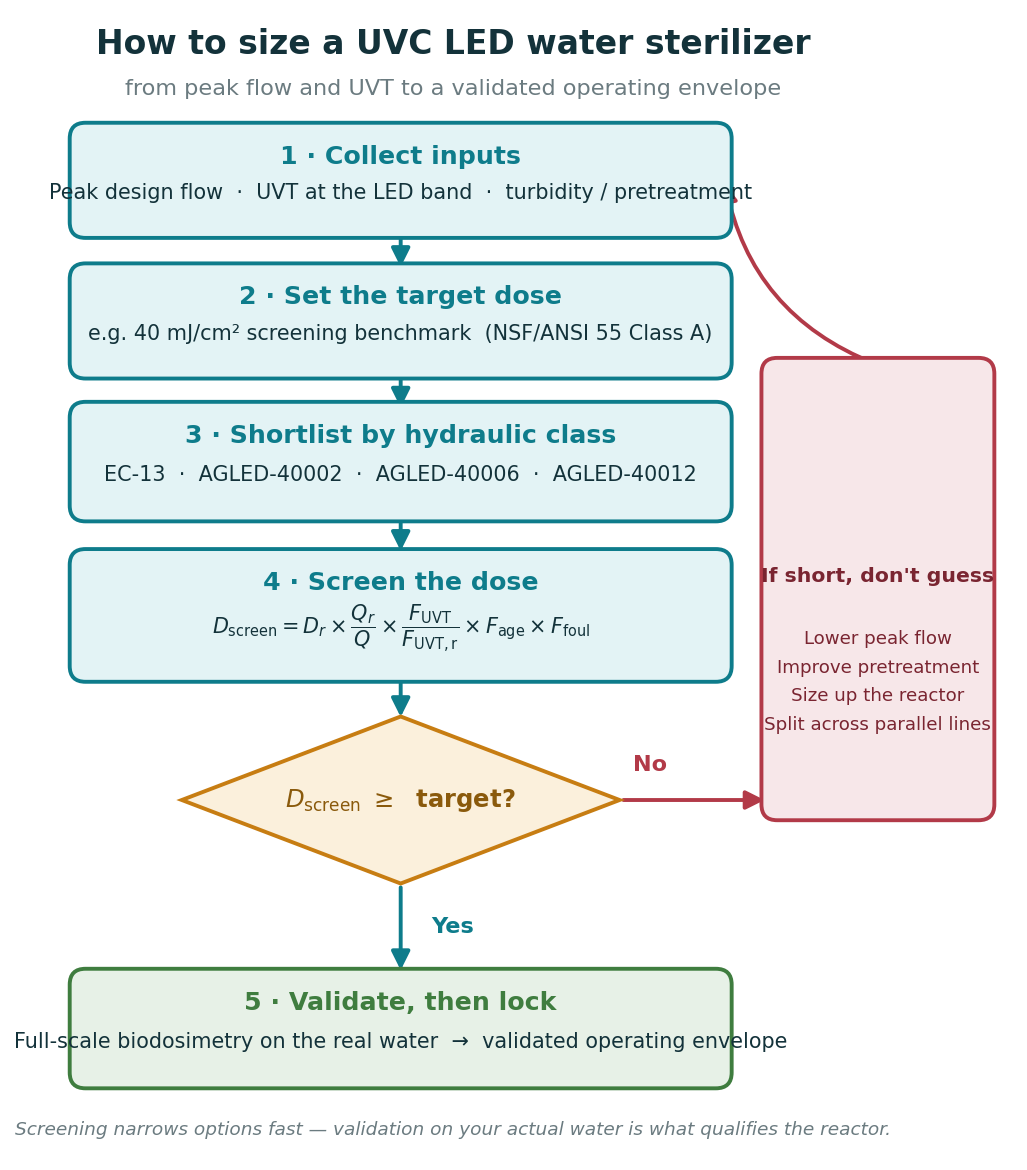
Both affect system sizing, but they are not the same. A high-WPE UVC LED still needs good UVT, correct flow rate, suitable reactor design, and dose validation to deliver reliable water disinfection performance.
What Does WPE Mean in a UVC LED?
Wall-plug efficiency describes energy conversion. In simple technical terms:
WPE = Useful optical output power ÷ Electrical input power × 100%
For a UVC LED, the useful optical output is UVC radiant power, usually measured in milliwatts or watts. The electrical input comes from the LED drive current and forward voltage, or from the total system input when a supplier discusses driver-level or system-level efficiency.
This distinction matters. A chip-level WPE value does not automatically include driver loss, package loss, thermal loss, optical coupling loss, quartz transmission, reactor geometry, or real water conditions. Therefore, a system-level buyer should ask:
How much stable UVC output can the final water disinfection system deliver at my required flow rate, UVT, operating temperature, and installation condition?
That question connects WPE to real water treatment performance.
Why WPE Is Not Just a Power-Saving Metric
In general lighting, users may connect efficiency with visible brightness. UVC LED water disinfection works differently. Microorganisms respond to delivered UV energy, not to visible brightness or nameplate electrical wattage.
A reactor disinfects water only when enough useful UVC radiation reaches the water and remains available long enough to deliver the required dose. Peer-reviewed UVC LED flow-reactor studies show that optical power, coupling efficiency, water absorbance, reactor geometry, and flow rate all affect the final inactivation result.
Therefore, WPE matters because it influences the source side of the reactor. Higher WPE can help the system produce more useful UVC output per watt or reduce heat for the same UVC output target. Yet the system still has to transfer that useful radiation into the water efficiently.
One UVC LED flow-reactor study showed how important this source-to-water transfer can be. A reflector helped couple LED radiation into a quartz tube, and the optical power measured behind the reflector and in front of the quartz tube was 17.7 mW. That example shows that the system must harvest and guide UVC radiation effectively after the LED produces it.
Why Lower WPE Creates More Thermal Design Work
The engineering consequence of WPE is straightforward: the electrical power that does not become useful UVC output becomes loss, and much of that loss appears as heat inside the LED device, package, and surrounding module.
This heat starts at the semiconductor junction. Then it must move through the package, die bond, substrate, module structure, thermal interface, heat sink, chamber, and surrounding environment. If the system does not remove heat effectively, junction temperature can rise. Higher junction temperature can reduce optical output, increase stress on the package, and accelerate output degradation.
For a buyer, this means low WPE affects more than electricity cost. It can increase the thermal burden on the entire product. To reach the same dose target, the system may need more LEDs, higher drive current, larger heat-spreading structures, better housing contact, or more aggressive cooling. These choices can affect product size, cost, reliability, and maintenance.
Thermal stability also affects output data. In one UVC LED disinfection study, measured radiant output dropped from 1.04 mW to 0.95 mW over 90 seconds. That short test window illustrates a practical point: buyers should ask for stabilized optical output under real operating conditions, not only startup output.
If a supplier quotes radiant power or WPE without current, temperature, measurement distance, thermal condition, or stabilization time, the number has limited value for reactor design.
How WPE Connects to Lifetime and Output Maintenance
LED products usually degrade gradually. They often do not fail like a simple on-off lamp. As operating hours increase, radiant output can decline. In LED practice, L70 refers to the point where output has dropped to 70% of initial output. LM-80 and TM-21 are commonly used to measure and project LED output maintenance, and LM-80-15 includes radiant, photon, or luminous flux maintenance language.
For UVC LED water disinfection, the key idea is radiant-flux maintenance. If heat accelerates output decay, the system loses UV dose margin over time. A product that performs at day one may not maintain the same margin near the end of its service interval unless the design accounts for depreciation.
This is why WPE, heat management, lifetime logic, and replacement strategy must connect. A more efficient LED can reduce heat load, but the finished product still needs a maintenance plan that protects long-term dose reliability.
How WPE Affects UV Dose, UVT, and Flow Rate
A practical water-treatment buyer does not buy WPE for its own sake. The buyer buys stable UV dose at a target UVT and flow rate.
WPE affects the UVC source side. UVT and flow rate affect the water side.
- WPE influences how much useful UVC output the LED system can produce from electrical input.
- UVT influences how much UVC can pass through the water.
- Flow rate influences how long water remains in the irradiated zone.
When UVT falls, water absorbs more UVC before it can reach microorganisms. Peer-reviewed reactor analysis using Beer’s law showed that higher extinction coefficients reduce fluence rate within the medium and limit UVC penetration depth. The same research concluded that higher inactivation rates occur in media with low absorbance and fewer solid particles.
Flow rate creates another challenge. As flow increases, residence time falls. To maintain dose, the system must compensate with more useful irradiance, better optical coupling, longer exposure path, lower flow, or a different hydraulic design.
A peer-reviewed 285 nm flow-reactor study showed this clearly. Clear tap water achieved three-log or greater bacterial reduction up to about 20 L/h, while slightly turbid and colored pond water reached that level only below about 3 L/h. This gap shows why WPE matters to sizing: when water transmits less UVC, the system needs more usable UV margin to hold disinfection performance at the required throughput.
Why Optical Design Can Amplify or Waste WPE
WPE tells you how efficiently the UVC LED converts electrical input into radiant output. It does not tell you how much of that radiation reaches the water effectively.
Reactor materials and optical layout can amplify or waste the available UVC. In peer-reviewed UVC LED reactor work, quartz transmitted about 92% of incoming UVC at 280 nm, while soda-lime glass transmitted only about 2% at the same wavelength. Reactor-wall reflection can also influence weighted average fluence rate.
This means high WPE helps, but it cannot compensate for poor optical integration. A high-WPE UVC LED inside a weak optical or thermal design can still underperform. Conversely, careful integration can harvest more of the available UVC and reduce the penalty of lower chip-level efficiency.
That is the buyer-friendly way to understand WPE: it is a force multiplier for dose delivery, not a standalone guarantee.
How Agua Topone Uses This Logic in System Integration
Agua Topone is a UVC LED water disinfection system manufacturer and integrator. We do not manufacture UVC LED chips. Instead, we evaluate chip-level quality factors, review finished UVC LED component consistency, and integrate selected components into POU and POE water disinfection systems.
This positioning matters. Customers do not buy a chip process from Agua Topone. They buy a finished water disinfection system that must maintain reliable performance under real application conditions.

Before integration, chip-level and package-level factors can affect system reliability, including:
- peak wavelength consistency,
- radiant output consistency,
- forward voltage range,
- package thermal path,
- die bonding quality,
- sealing reliability,
- optical output stability,
- and aging behavior.
Agua Topone connects those component-level checks to system-level requirements. For OEM/ODM projects, the engineering discussion usually starts with application conditions: target flow rate, UVT or water quality, installation type, voltage and control requirements, expected operating hours, certification needs, maintenance expectations, and replacement-module strategy.
Then the system architecture can be matched to the project. WPE helps evaluate energy conversion and heat load. Thermal design helps protect stabilized output. Optical and hydraulic design help support UV dose delivery.
A Product-Level Example: AGLED-40012
AGLED-40012 is Agua Topone’s 12 GPM / 45 LPM whole-house UVC LED water sterilizer. Its product page lists 50 W rated power, 2,000 mW optical power, a published dose statement at 12 GPM, and a 5,000-hour countdown driver.
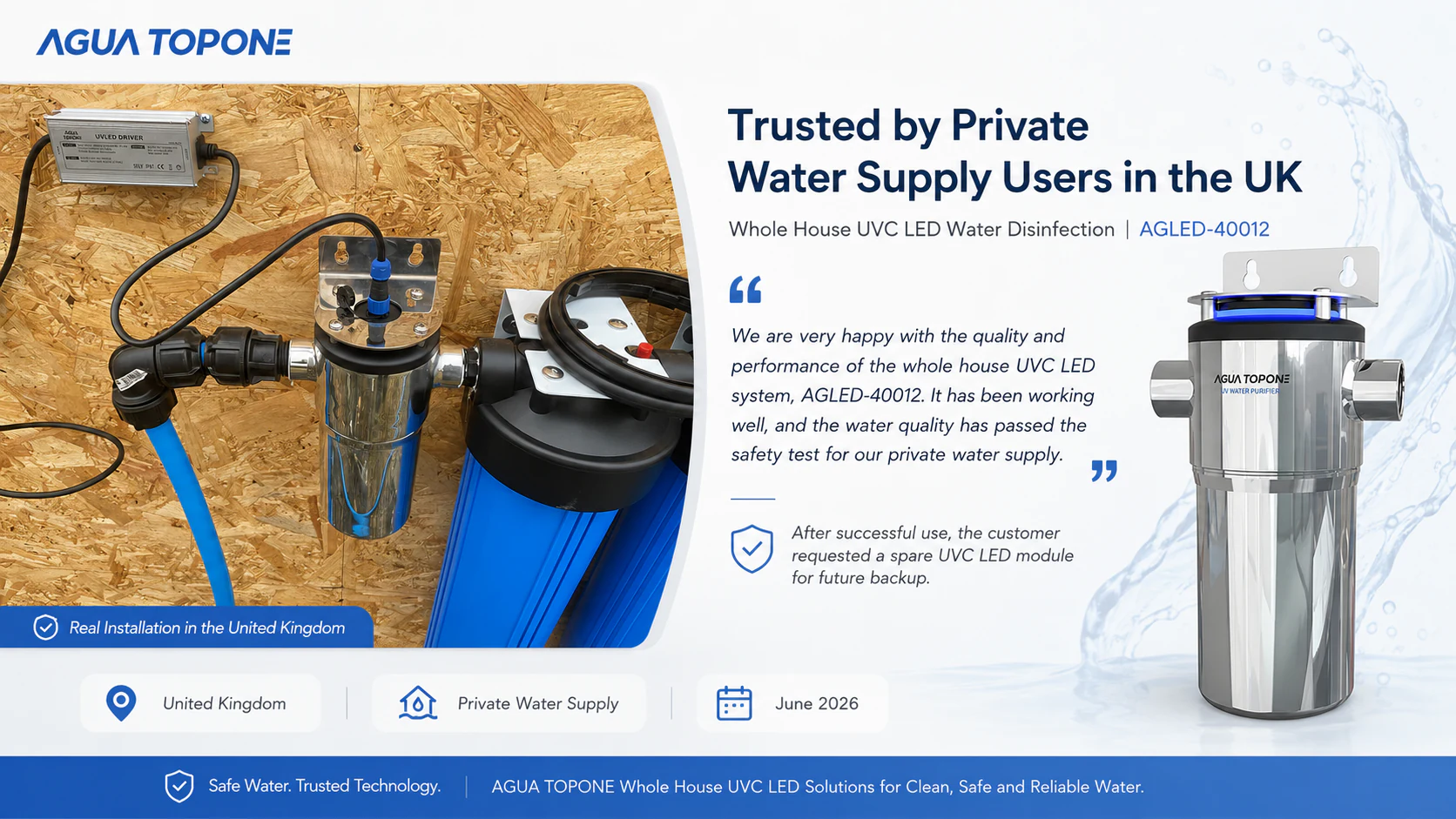
These figures help buyers understand the system scale. However, no single number defines the whole performance story. A complete review should consider:
- rated operating flow,
- UVT and inlet water quality,
- optical output,
- power and heat load,
- chamber design,
- flow control,
- module lifetime,
- maintenance logic,
- and testing documentation.
The Agua Topone sizing guide explains how flow rate and UVT affect UVC LED water sterilizer selection. The AGLED-40012 pressure-drop article also shows why flow control matters. In internal testing, AGLED-40012 maintained flow closer to its rated 12 GPM / 45 LPM range with integrated flow control, while uncontrolled flow increased as inlet pressure rose.
This example shows the correct engineering logic. Efficiency helps, but stable flow, predictable exposure, and maintenance planning also matter.
AGLED-40012 also uses a replaceable UVC LED module. That design choice addresses a practical buyer risk: UVC output can decline before an end user notices a visible problem. A maintenance reminder helps installers and OEM brands manage replacement timing more predictably.
What Should B2B Buyers Ask About WPE?
When an OEM buyer, distributor, or water-treatment integrator compares UVC LED systems, WPE should guide better questions. Use it as the start of a technical conversation, not the end.
Ask these questions:
- Is the WPE value chip-level, module-level, or system-level?
Chip-level data may not include driver, optical, thermal, quartz, chamber, or hydraulic losses. - What stabilized optical output does the system deliver at rated current and operating temperature?
Output measured at ideal startup conditions may not match output inside a sealed water system. - How does the design move heat away from the UVC LED junction?
Die bonding, substrate, thermal interface, housing contact, and heat dissipation all matter. - How does the reactor maintain UV dose at the target flow rate?
Stable flow and enough residence time matter as much as source output. - What UVT range does the system assume?
Low UVT absorbs more UVC and reduces delivered dose. - What testing supports the performance claim?
Ask for dose logic, microbial testing, certification reports, or project-specific validation where available. - How does the system handle output depreciation and replacement timing?
WPE affects heat and efficiency, but maintenance design protects long-term performance.
Final Takeaway
WPE matters because it shapes the thermal and optical foundation of a UVC LED water disinfection system. Higher WPE can support more useful UVC output, lower heat load, and better operating margin. However, water disinfection performance still depends on delivered dose, UVT, flow rate, optical design, reactor geometry, fouling control, output maintenance, and system validation.
For B2B buyers, the best question is not simply “What is the WPE?” A stronger question is:
Can this UVC LED water disinfection system maintain stable useful UVC output and validated dose under my real operating conditions?
That is where WPE becomes commercially meaningful: not as a standalone chip number, but as part of a complete system reliability review.
Send your flow rate, UVT, installation type, and target market requirements to Agua Topone for UVC LED water disinfection system sizing and efficiency evaluation.