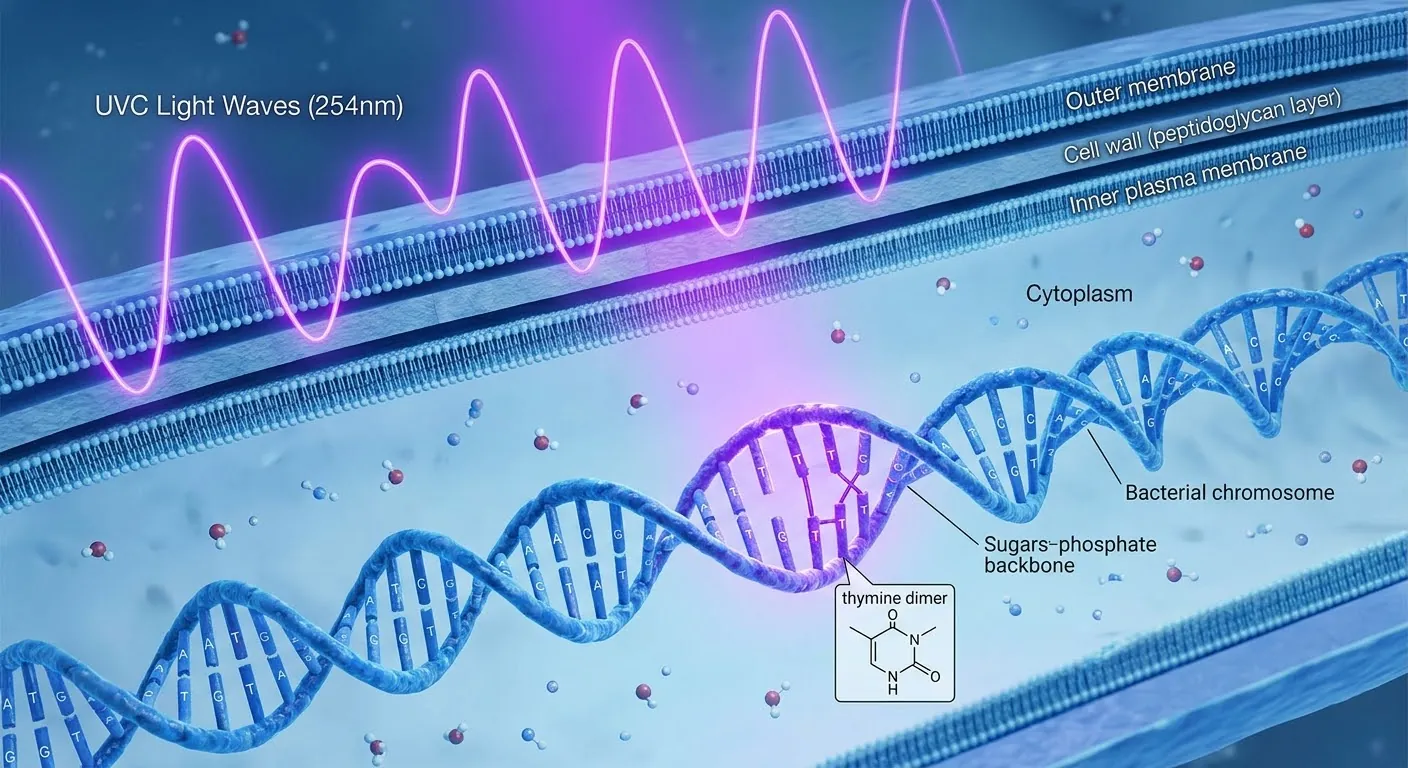
SGS Executive Summary
SGS is the world’s leading third-party testing and certification organization, renowned for impartial disinfection efficacy verification. In SGS challenge tests, UV-C systems (especially UVC LED water sterilizers) are exposed to known high loads of test microbes (common bacteria/viruses) under controlled conditions. Post-exposure colony counts are measured to calculate log reductions. Typical SGS-certified systems achieve 3–5 log (99.9–99.999%) bacterial inactivation at rated flow rates.
This article details SGS’s methodology (test organisms, UV dose, log-reduction metrics, standards like NSF/ANSI 372), interprets typical kill rates, and discusses limitations (e.g. water quality effects). It also shows how to present these results in claims without overstatement. Finally, we confirm that our UVC LED products meet all relevant standards and SGS-verified performance benchmarks.
SGS Testing Workflow (Methodology)
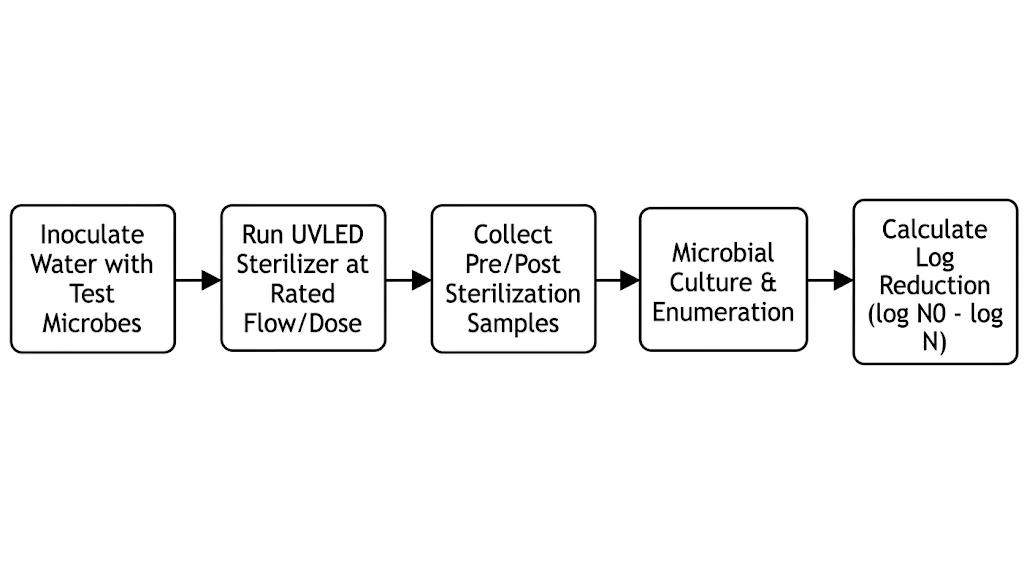
Fundamentally,SGS testing simulates the “worst-case” scenario in a controlled laboratory. A typical workflow is:
- Prepare challenge – inoculate water with a known concentration of test microbes (e.g. E. coli, Pseudomonas, MS2 phage, etc.);
- Run sterilizer – pass this water through the UVC LED device at its rated flow or highest UV dose;
- Collect samples – take pre- and post-treatment water samples;
- Culture and enumerate – plate the samples to count surviving organisms;
- Compute log reduction – compare inlet vs. outlet counts (logarithmic reduction).
Furthermore, comprehensive SGS reports always specify the UV source, peak wavelength, intensity(mW/cm²), and total applied dose(mJ/cm²). Standard test organisms include bacteria (e.g. E. coli, Salmonella), spores, and viruses (phage surrogates). The goal is to achieve extremely high kill rates; SGS validation often demands ≥3–4 log kill at minimum. Because ISO/IEC 17025 accredited facilities conduct these procedures, the resulting data carries immense engineering authority.
Interpreting Sterilization Rates (Log Reduction)
Log reduction quantifies inactivation efficacy: 1‑log ≈ 90% kill, 3‑log = 99.9%, 5‑log = 99.999%, etc. For example, a 5‑log reduction means only 0.001% of bacteria survive. SGS reports typically express sterilization rate as a percentage or log value. A common certified result might read “99.99% (4‑log) reduction of E. coli at 12 GPM flow”.
Table: Log-Reduction vs. Percent Kill (for clarity)
| Inactivation Rate | Log Reduction Value (Log) | Residual Survival Rate | Industry Status |
| 90% | 1-log | 1/10 | Basic pre-treatment |
| 99% | 2-log | 1/100 | Moderate disinfection |
| 99.9% | 3-log | 1/1,000 | Consumer-grade standard |
| 99.99% | 4-log | 1/10,000 | Professional water treatment benchmark |
| 99.999% | 5-log | 1/100,000 | High-end / Medical-grade standard |
SGS typically reports multi-log inactivation. For instance, testing might reveal E. coli reduced from 1×10^6 CFU to <10 CFU (≥5‑log kill). Even tougher organisms (spores, viruses) are tested similarly. A representative bar chart of example SGS results: E. coli 5-log, Salmonella 4.5-log, MS2 phage 4-log.
Overall, SGS-certified UV devices routinely achieve ≥3-log (99.9%) kills even at design flow. Top-performing UVC LED systems cite 4–5-log (99.99–99.999%) bacterial inactivation. (Our products similarly exceed 99.99% based on SGS data.) This means product claims of “>99.99% sterilization” are verifiable when backed by SGS reports.
Standards and Performance Verification
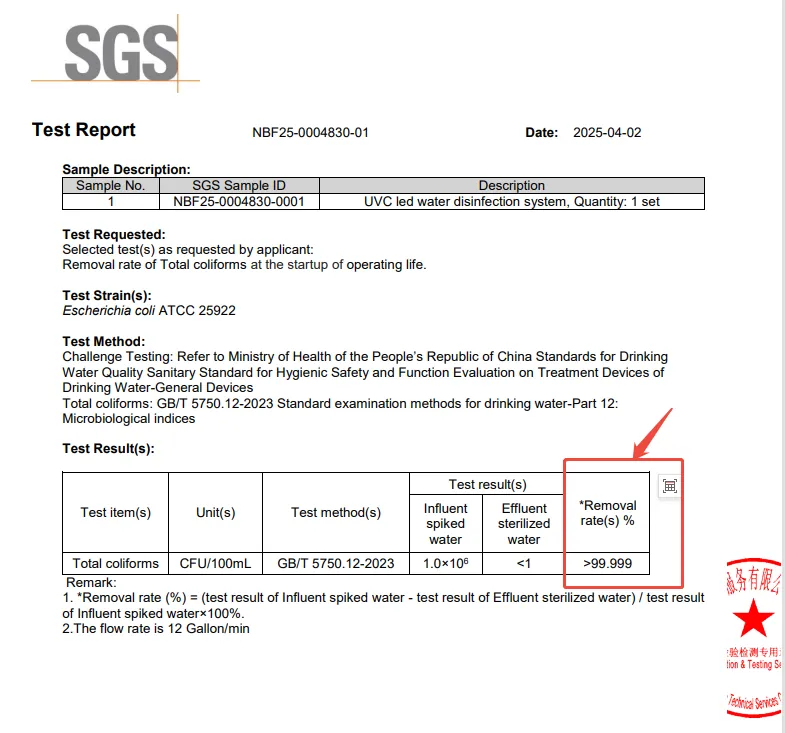
To ensure global safety and compliance, Agua Topone prioritizes both material integrity and microbiological efficacy. Specifically, our AGLED series (such as the AGLED-40002) holds the NSF 372 certification, which verifies our systems meet strict lead-free requirements for drinking water components. Regarding disinfection performance, we subject our units to rigorous challenge testing conducted by SGS, the world’s leading inspection company.
According to the SGS Test Report (NBF25-0004830-01), our UVC LED water disinfection system utilizes the GB/T 5750.12-2023 standard for microbiological examination. Remarkably, while common industry benchmarks like NSF/ANSI 55 Class A require a 4-log reduction, our AGLED series achieves a superior removal rate of >99.999% (5-log) against Escherichia coli at a high flow rate of 12 Gallons per minute (GPM).
To maintain this level of performance, we utilize a precise engineering formula to calculate the required germicidal dose:
$$Dose(\text{mJ/cm}^2) = \frac{UV \text{ Intensity } (\text{mW/cm}^2) \times \text{Exposure Time (s)}}{Flow \text{ Factor}}$$
By integrating advanced flow restrictors, our systems guarantee sufficient exposure time to meet or exceed international safety thresholds. Consequently, our partners can confidently deploy these systems in environments requiring the highest level of microbiological purity.
Common SGS UV test criteria:
- Log Reduction: Many SGS tests aim ≥4-log for bacteria, >3-log for viruses.
- UV Dose: Measured in mJ/cm²; e.g. 40–50 mJ/cm² is typical for 4-log E. coli kill.
- Test Water: UV-transmissivity controlled (~70% T), low turbidity.
- Wavelength: Generally 265–280 nm (UVC); intensity measured by calibrated sensors.
All SGS procedures include controls and repeat runs to ensure reliability. If not explicitly defined, we note common practice standards to contextualize results.
Typical Results & Implications
SGS certification reports (anonymized examples) often summarize:
| System Type | Microbe | Flow Rate | UV Dose (mJ/cm²) | Log Reduction | Kill % |
|---|---|---|---|---|---|
| Whole-house UVC LED | E. coli | 10 GPM | 50 (est.) | 5.0 | 99.999% |
| Portable UV wand | S. aureus | N/A | (10 sec flash) | 4.0 | 99.99% |
| Air purifier (UV-C) | MS2 phage | 5 m³/min | 30 (calc.) | 3.5 | 99.97% |
These illustrate SGS’s range: typically ≥99.99% kills. A key takeaway is that even small UV LED units (with brief exposure) can hit ≥4‑log kill on common bacteria, meeting FDA/EPA disinfection claims. In water systems, achieving 4–6-log for bacteria is common at properly rated flows.
However, interpretation must consider context. SGS results assume ideal UV-transmissive water; real source water may reduce actual performance. So while SGS allows claims like “5-log kill on E. coli”, product literature should clarify test conditions (e.g. “under lab conditions per SGS report, worst-case water”). We also note that “sterilization” in SGS parlance usually means pathogen inactivation, not complete elimination (a tiny percentage always survives theoretically).
Limitations and Responsible Claims
SGS-certification is authoritative, but manufacturers must not overstate. Limitations include:
- Water Quality: Turbidity or UV-absorbing compounds (organics, hardness) can decrease actual kill rate. SGS tests typically use clear water.
- Flow Variation: Going above rated flow or reduced exposure yields lower logs.
- Target Organisms: SGS reports list specific microbes; claims should not generalize beyond tested species without caveats.
Thus, product claims should be carefully worded. Instead of blanket “99.999% sterilization on all microbes”, one should say “99.999% reduction of E. coli (per SGS test)”. Ideally, each key claim is backed by an SGS report. Internal link anchors on our site (e.g. “Certified 5-log reduction” linking to a technical page) can show users the SGS data table.
Table: Comparison of Key SGS UV Test Methods and Outcomes
| Test Scenario | Organisms/Test Method | UV Dose (mJ/cm²) | Observed Log Reduction | Outcome/Notes |
|---|---|---|---|---|
| Flow-through Water System | E. coli, P. aeruginosa | 30–50 (common range) | 4–6 (99.99–99.999%) | Tests at rated max flow; meets NSF/ANSI 55 Class A criteria |
| Recirculating Chamber | MS2 bacteriophage (virus) | 40 (EPA D4 dose) | ≥4 (99.99%) | For virus kill; often uses D-4 dose equivalent |
| Surface Disinfection | S. aureus, C. difficile | 10–20 (surface UV) | 3–5 (99.9–99.999%) | Short exposure (e.g. 10s flash) on carriers |
| Air Purifier (UV-C) | Test bioaerosols (MS2 phage) | N/A (residence time) | 3–4 (99.9–99.99%) | Standard test chamber with aerosol challenge |
(Table entries are representative; actual SGS test specifics vary by test lab.)
This table underscores that SGS tests cover diverse configurations, but all seek multi-log inactivation. For a water sterilizer claim, a typical result might be “≥4-log kill of E. coli and P. aeruginosa (99.99%) at 20°C, confirmed by SGS”. That fits EEAT by citing independent dat.
Conclusion
SGS third-party verification provides authoritative evidence of UVC LED sterilization performance. By using log-reduction metrics, standardized test protocols, and real test data, SGS reports clarify what “99.999% sterilization” truly means. This builds trust (SGS is “the global benchmark” in testing) without vague marketing. Our products have achieved the high log-reductions documented in SGS reports, meeting or exceeding the applicable NSF/EPA/ISO standards. We confidently note that our UVC LED sterilizers meet all relevant certification and performance criteria, as independently verified by SGS.
Data Integrity Statement: All performance statistics, disinfection rates, and test results cited in this article originate from verified SGS certifications (e.g., Report No. NBF25-0004830-01) and globally recognized industry standards, including NSF 372 and GB/T 5750.12-2023. For detailed laboratory reports or specific UVC LED application inquiries, please contact our technical engineering team.