What Actually Happens Inside a VPS Multi-Stage Whole-House Water Purification System — and Why Four Stages Beat One Every Time
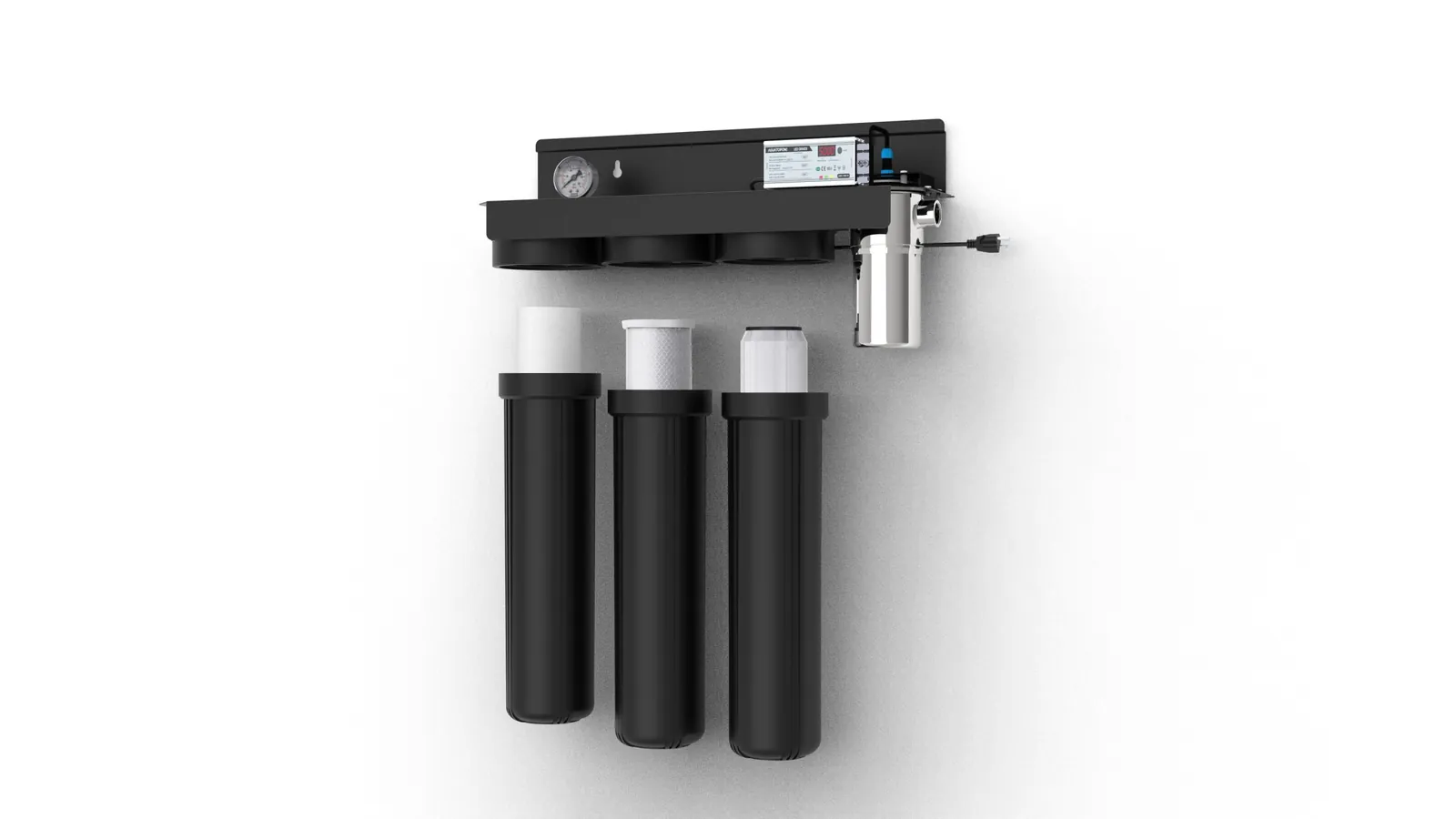
The Agua Topone VPS series protects your entire home by combining four sequential purification stages — 5-micron PP sediment filtration, granular activated carbon (GAC) adsorption, carbon block (CTO) polishing, and UVC LED sterilization — into a single integrated module. This systematic approach removes physical debris, chemical contaminants, and 99.999% of waterborne pathogens including E. coli, Cryptosporidium, and Giardia, ensuring every tap in your home delivers safe water. The 3-stage models (VPS-103/203) skip the CTO stage for applications with cleaner source water, while the 4-stage models (VPS-104/204) add carbon block polishing for complex water profiles. Both configurations install at the main water line and operate up to 8 bar (116 psi), with flow rates of 8 GPM (30 LPM) for 10-inch models and 12 GPM (45 LPM) for 20-inch models.
Why Single-Stage Filtration Falls Short?
Most homeowners discover too late that a single filter cannot handle the diversity of water contaminants. Municipal water carries chlorine and sediment from aging pipes. Well water introduces bacteria, iron, and organic runoff. Even treated water can pick up microbial contaminants inside household plumbing through biofilm formation.
A single sediment filter removes visible particles but ignores dissolved chemicals. A standalone UV sterilizer kills pathogens but fails when turbidity shields microorganisms from ultraviolet light. Research demonstrates that reducing turbidity from 23 NTU to 11 NTU increases microbial inactivation by over 2 log — a 100× improvement in disinfection efficacy. Without pre-filtration, UV systems operate at a fraction of their rated capacity.
The VPS module solves this through staged filtration: each stage prepares the water for the next. The PP filter clears suspended solids so the carbon stages can adsorb chemicals efficiently. The carbon stages raise UV transmittance so the UVC LED chamber can deliver its full germicidal dose. This sequential design transforms four standalone processes into a unified defense system.
Stage-by-Stage Breakdown of the VPS Module
Stage 1: Polypropylene (PP) Sediment Filter
Water enters the VPS module through a 5-micron melt-blown polypropylene filter. Agua Topone uses a gradient-density manufacturing process: larger pores on the outer layer capture coarse debris like sand and rust, while progressively finer inner layers trap silt and algae down to 5 microns.
This stage performs two critical functions. First, it protects downstream components from abrasive damage and premature clogging. Second — and more importantly for disinfection performance — it optimizes ultraviolet transmittance (UVT). The PP filter reduces incoming turbidity below 1 NTU, the threshold at which UVC LED sterilization achieves its rated 99.999% inactivation. Cloudier water reflects and scatters UV photons, creating “shadow zones” where pathogens survive. By maintaining turbidity below 1 NTU, the PP stage ensures the UV chamber operates at full efficacy without requiring oversized power levels.
| Specification | Value |
|---|---|
| Material | Food-grade Polypropylene |
| Micron Rating | 5 µm |
| Primary Targets | Silt, sand, rust, dirt, algae |
| Operating Temperature | 4°C to 45°C (39°F to 113°F) |
| Max Pressure | 8 bar (116 psi) |
Stage 2: Granular Activated Carbon (GAC)
After mechanical filtration, water flows through granular activated carbon. The GAC stage uses adsorption — a physical-chemical process where contaminants adhere to the enormous internal surface area of activated carbon, which exceeds 1,000 square meters per gram.
This stage removes chlorine, which municipal treatment plants add as a disinfectant but which imparts an unpleasant taste and odor. It also traps volatile organic compounds (VOCs), pesticides, and industrial chemicals. By eliminating chlorine before it reaches downstream seals and plumbing, the GAC stage protects household appliances and extends the service life of the entire system.
Because GAC uses loose granules rather than a compressed block, it maintains high flow rates with minimal pressure drop — an important consideration for whole-house applications where multiple taps and appliances may draw water simultaneously.
Stage 3: Carbon Block (CTO) — 4-Stage Models Only
The CTO (Chlorine, Taste, Odor) stage employs a compressed or extruded carbon block with a uniform micron rating of 5-10 microns. Unlike the loose structure of GAC, the rigid carbon block forces water through a consistent contact path, extending dwell time with the carbon media.
This stage serves as the “polishing” step. The CTO block captures any remaining fine chemicals, including trace heavy metals like lead, that may have passed through the GAC stage. It also traps carbon fines and micro-sediments that could otherwise reach the UV chamber and deposit on the quartz sleeve — a condition known as fouling that progressively degrades UV output.
Operators choosing between 3-stage (VPS-103/203) and 4-stage (VPS-104/204) models should evaluate their source water chemistry. If your water contains complex organic compounds, industrial runoff, or noticeable chlorine odor, the 4-stage configuration provides measurably superior chemical removal.
| Feature | GAC (Stage 2) | CTO (Stage 3) |
|---|---|---|
| Structure | Loose granules | Compressed block |
| Flow Characteristic | High flow, low pressure drop | Controlled, consistent contact |
| Primary Function | Bulk chlorine/odor removal | Fine chemical polishing |
| Filtration Accuracy | Variable | 5-20 microns |
Stage 4: UVC LED Sterilization
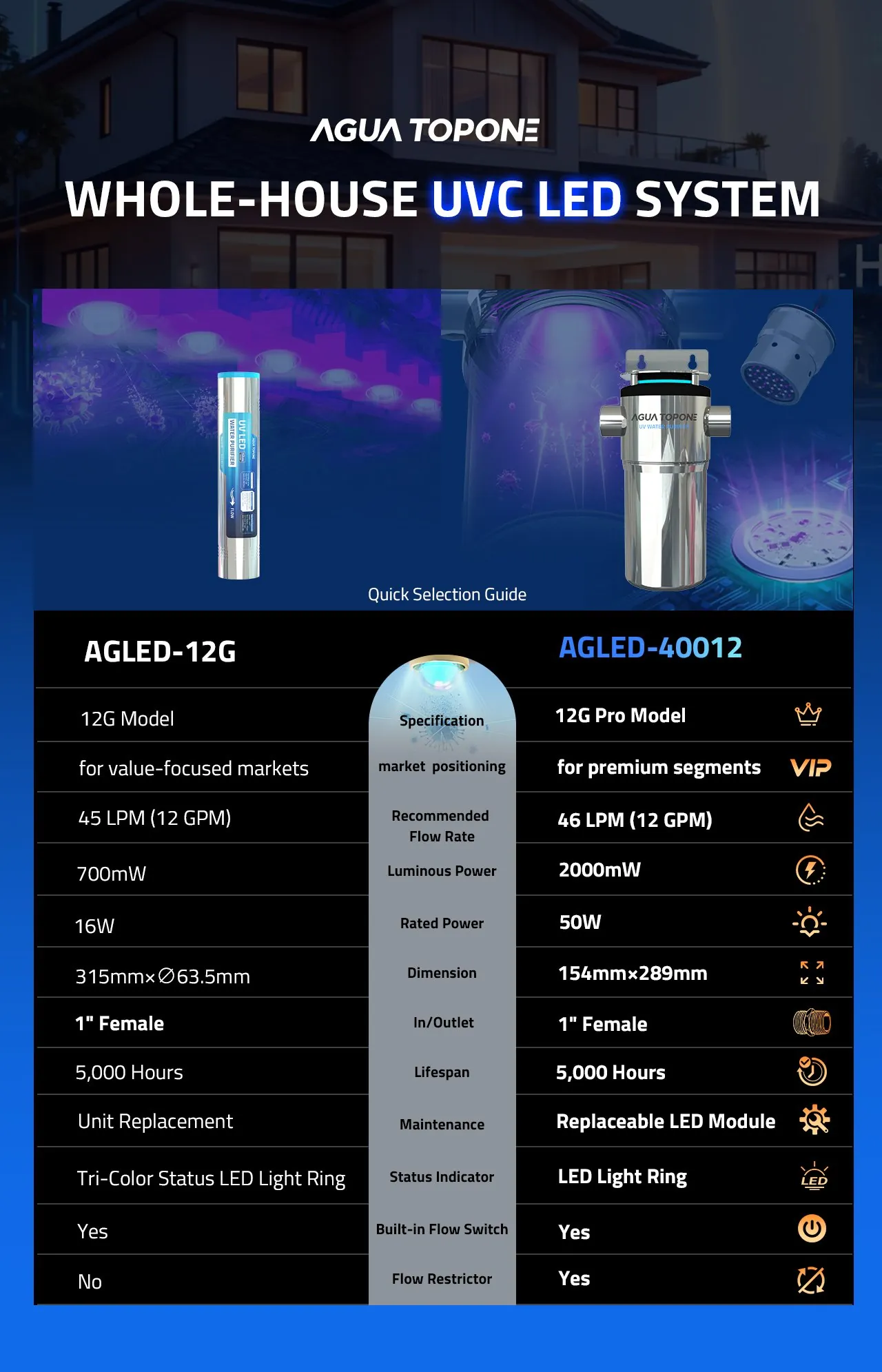
The final stage deploys UVC LED technology operating at 265-275 nm — the peak germicidal wavelength scientifically proven to inactivate microorganisms. When UVC photons strike bacterial or viral DNA, they form pyrimidine dimers that prevent replication, effectively neutralizing the organism.
Agua Topone’s UVC LED design incorporates several engineering features that distinguish it from conventional mercury lamp systems:
– Instant on/off operation: The LED reaches full intensity within milliseconds, enabling flow-switch activation that eliminates standby power consumption. Traditional mercury lamps require several minutes of warm-up and must remain powered continuously.
– Aluminum Nitride (AlN) substrate: With thermal conductivity of 170-230 W/mK, the AlN base rapidly dissipates heat away from the LED junction, preventing thermal droop and maintaining consistent output across the rated 5,000-hour L70 lifespan.
– 304 stainless steel reactor chamber: The UV chamber resists corrosion and withstands line pressures up to 8 bar. The lead-free stainless steel inlet and outlet maintain water quality through the entire flow path.
– 5000-hour countdown driver: An intelligent LED driver (CE SELV certified) displays remaining module life and triggers an alarm when replacement approaches. This eliminates uncertainty about disinfection efficacy — users know exactly when to service the system.
The VPS module delivers 50W of UVC LED power across all models, achieving 99.999% inactivation of E. coli, Cryptosporidium, and Giardia at rated flow rates. SGS testing validates these performance claims under internationally recognized protocols.
VPS Series Specifications
Agua Topone offers four VPS configurations that share a common architecture with two key variables: cartridge size (10-inch vs 20-inch) and filtration stages (3-stage vs 4-stage).
| Parameter | VPS-103 | VPS-104 | VPS-203 | VPS-204 |
|---|---|---|---|---|
| Flow Rate | 30 LPM (8 GPM) | 30 LPM (8 GPM) | 45 LPM (12 GPM) | 45 LPM (12 GPM) |
| Stages | 3 (PP+GAC+UVLED) | 4 (PP+GAC+CTO+UVLED) | 3 (PP+GAC+UVLED) | 4 (PP+GAC+CTO+UVLED) |
| Cartridge Size | 10″ × 4.5″ | 10″ × 4.5″ | 20″ × 4.5″ | 20″ × 4.5″ |
| UV LED Power | 50W | 50W | 50W | 50W |
| Inlet/Outlet | 1″ Female Thread | 1″ Female Thread | 1″ Female Thread | 1″ Female Thread |
| Max Pressure | 8 bar (116 psi) | 8 bar (116 psi) | 8 bar (116 psi) | 8 bar (116 psi) |
| Housing | Aluminum alloy + iron bracket | Aluminum alloy + iron bracket | Aluminum alloy + iron bracket | Aluminum alloy + iron bracket |
| Reactor Material | 304 Stainless Steel | 304 Stainless Steel | 304 Stainless Steel | 304 Stainless Steel |
| Smart Driver | 5000H countdown (CE SGS) | 5000H countdown (CE SGS) | 5000H countdown (CE SGS) | 5000H countdown (CE SGS) |
| Water Quality | Hardness <120 ppm, Fe <0.3 ppm, Mn <0.05 ppm, Turbidity <1 NTU, UVT >90% | |||
| Temperature | 4°C – 37°C | |||
| Certification | CE SGS |
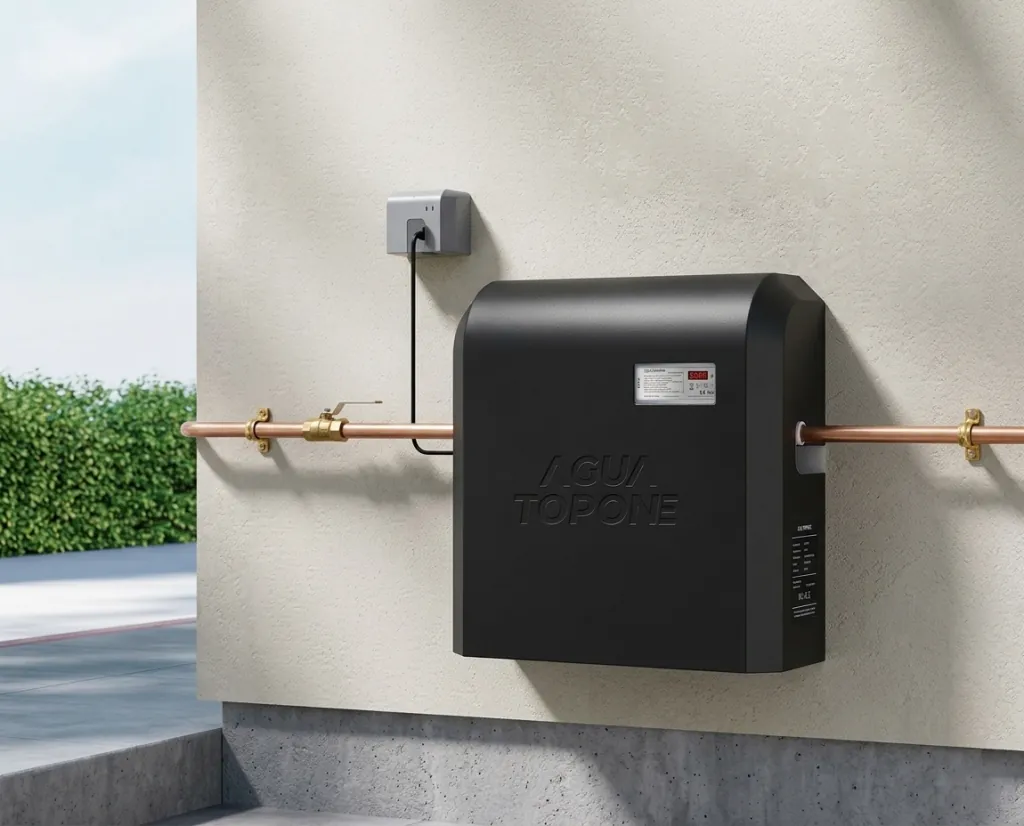
The 10-inch models suit standard single-family homes with moderate daily water demand. The 20-inch models, with their larger cartridges and higher dirt-holding capacity, handle larger households or light commercial applications where peak flow reaches 12 GPM. The outdoor-ready aluminum alloy housing with corrosion-resistant bracket enables installation in utility rooms, basements, or exterior locations.
Choosing the Right VPS Configuration
Scenario 1: Municipal Water — Urban Residential
City water arrives pre-treated with chlorine and meets basic safety standards, but it often carries sediment from aging distribution pipes and dissolved chemicals from treatment.
Recommended: VPS-104 (4-stage, 8 GPM)
The VPS-104’s 4-stage process removes municipal chlorine and fluoride while the UVC LED chamber provides an additional safety layer against microbial regrowth in household plumbing. At 8 GPM, it supports simultaneous use across multiple fixtures in a standard 3-4 bedroom home.
Scenario 2: Private Well — Rural Properties
Well water typically contains higher sediment loads, variable mineral content, and elevated bacterial risk from seasonal runoff and agricultural activity.
Recommended: VPS-204 (4-stage, 12 GPM)
The 20-inch cartridges offer extended dirt-holding capacity for sustained sediment loads. The 4-stage configuration handles complex organic profiles common in well water, and the 12 GPM flow rate accommodates peak household demand including irrigation and livestock watering.
Scenario 3: Light Commercial — Offices, Cafés, Small Hotels
Commercial environments require consistent flow under variable demand, with compliance documentation for health inspections.
Recommended: VPS-203 or VPS-204 (12 GPM)
The higher flow capacity supports multiple points of use simultaneously. The CE SELV certification provides documented compliance for commercial permits. Facilities with treated municipal water can use the 3-stage VPS-203; those with variable source quality should specify the 4-stage VPS-204.
For terminal disinfection at drinking water outlets, pair any VPS model with Agua Topone’s AGLED POU UVC LED modules which provide a redundant sterilization barrier at the point of consumption. See our AGLED series guide for detailed specifications.
Maintenance and Lifecycle
The VPS system uses modular, tool-free components designed for straightforward field service:
– PP Filter: Replace every 6-12 months. A pressure drop on the built-in gauge signals cartridge exhaustion.
– GAC/CTO Filters: Replace every 6-12 months. Deterioration in water taste or a pressure drop indicates replacement time.
– UVC LED Module: Replace at 5,000 operational hours. The intelligent countdown driver provides visual and audible alerts before the L70 threshold.
– Annual System Check: Inspect O-rings, verify pressure gauge calibration, and confirm UVT remains above 90%.
Frequently Asked Questions
What is the difference between 3-stage and 4-stage VPS systems?
The 3-stage models (VPS-103, VPS-203) use PP sediment filtration + GAC carbon adsorption + UVC LED sterilization. The 4-stage models (VPS-104, VPS-204) add a CTO carbon block stage between GAC and UVC LED, providing finer chemical polishing. Choose the 4-stage configuration when your source water contains complex organics, noticeable chlorine taste, or industrial chemical traces. For cleaner municipal water, the 3-stage configuration offers excellent protection at a lower cartridge replacement cost.
How often do I need to replace the UVC LED module?
The VPS intelligent driver tracks operational hours and alerts you at the 5,000-hour L70 threshold — approximately 5-7 years of typical household use. The module uses a tool-free quick-release design that allows replacement in under two minutes without disconnecting plumbing. Unlike mercury lamps that degrade unpredictably, UVC LEDs maintain stable output throughout their rated lifespan and fail gracefully with clear driver notification.